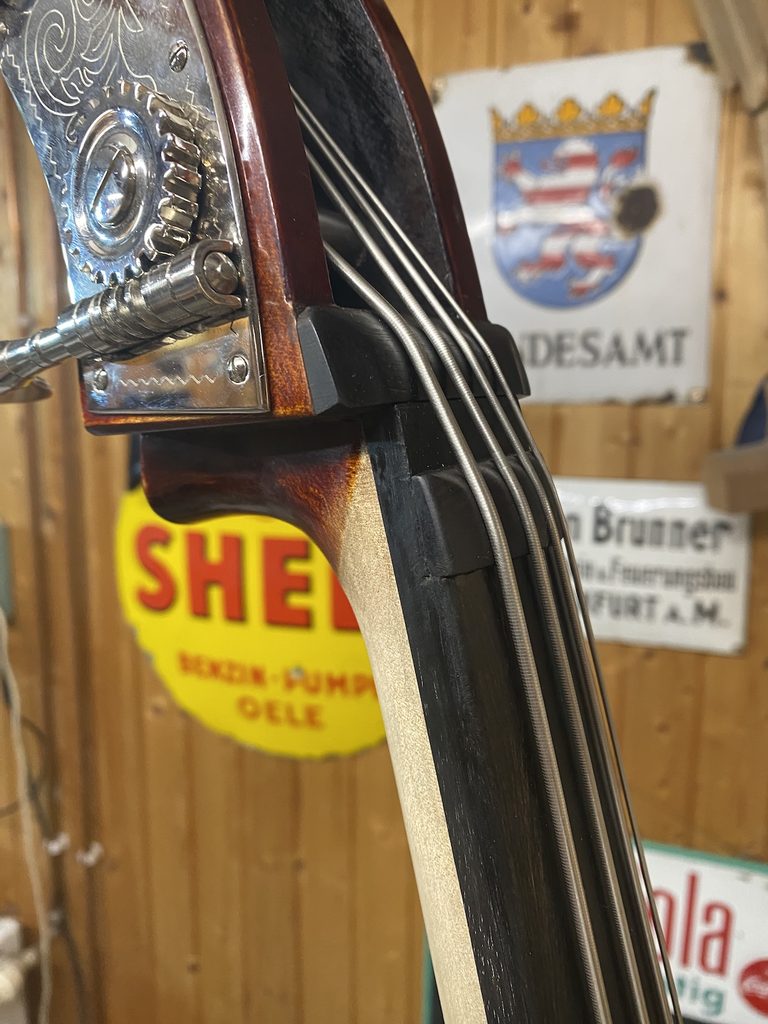
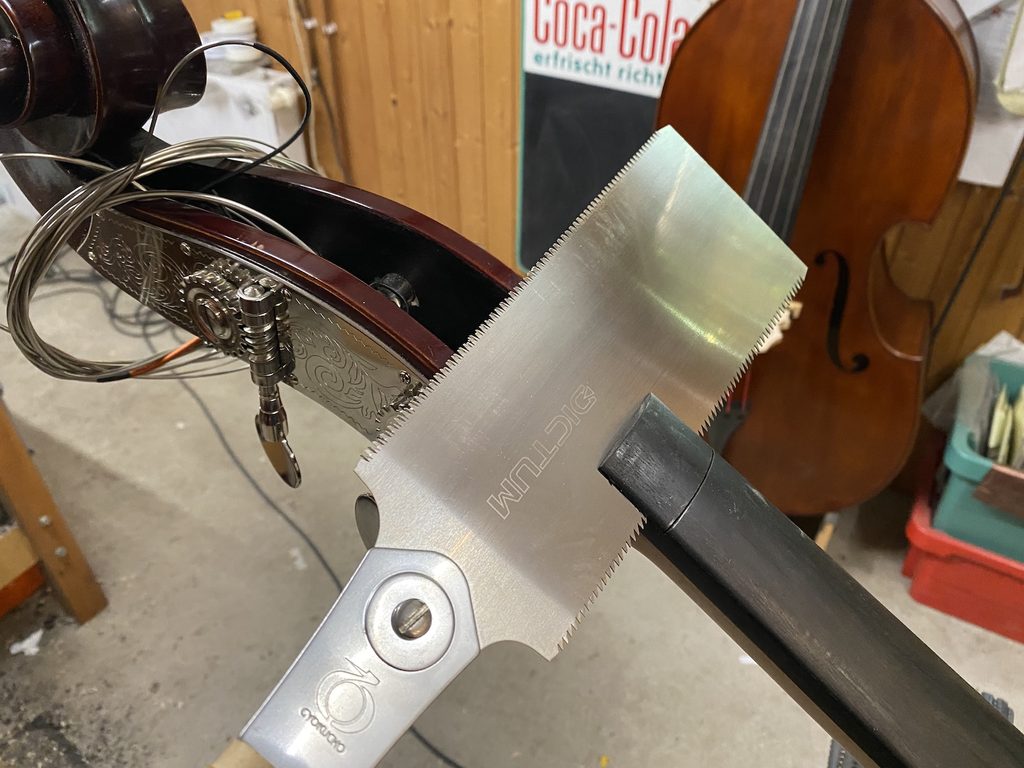
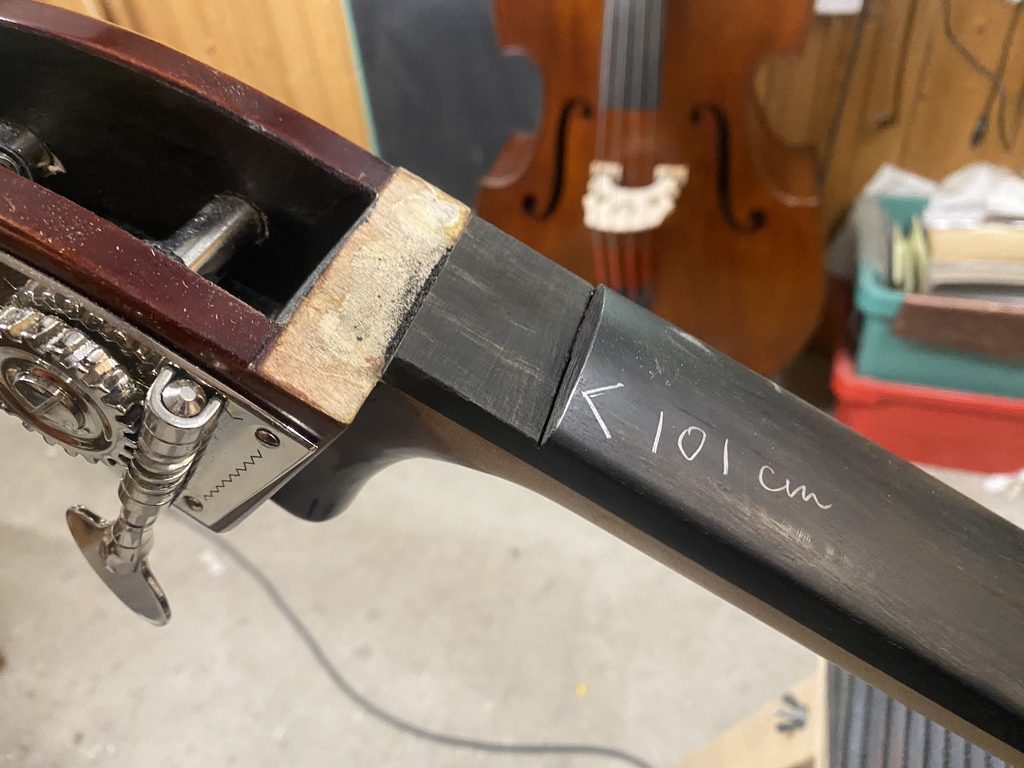
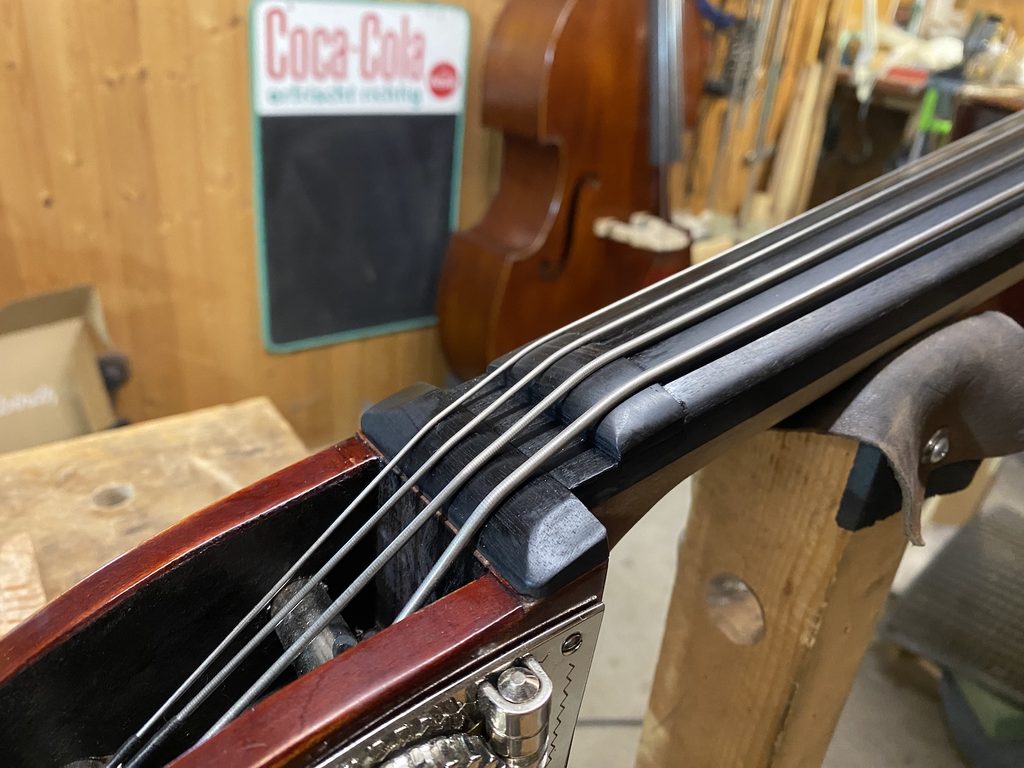
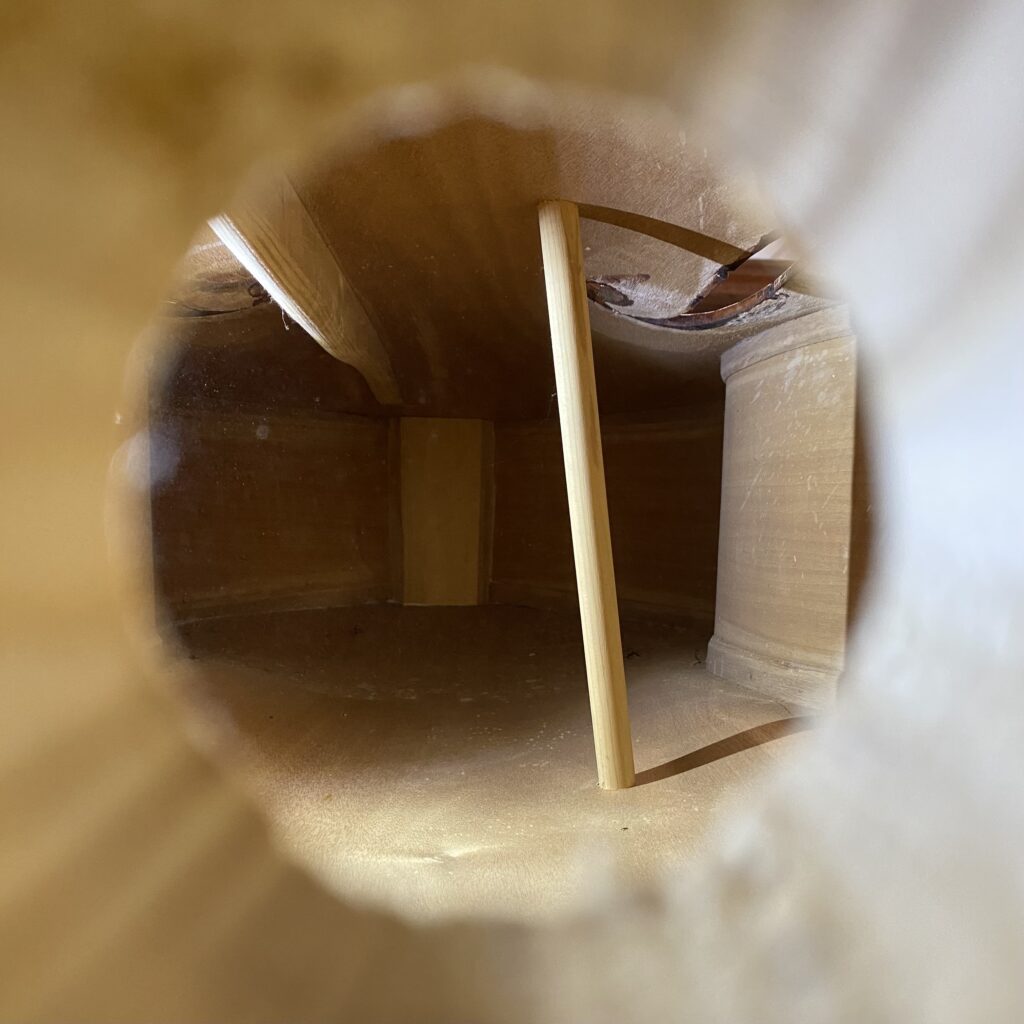
Some basses have an unwieldy long string length. As you can’t simply move the bridge, the only real way to change this is by fitting a new neck – or by using what is known (in Germany) as an ‘English nut’. The English nut shortens the playable string length from the pegbox. To achieve this, the fingerboard is shortened so that the upper nut is moved downwards.
This bass actually already had a comfortable string length of 104 cm – but the customer wanted 101 cm. To achieve this, I didn’t shorten the fingerboard completely, but instead cut out a step on which the new nut sits.
Naturally, the English saddle and the shortened scale length have also changed the position of all the notes on the fingerboard. So, to restore a D scale length, I also carved away a bit of wood at the base of the neck and rounded everything off nicely: now the D note played on the G string is once again opposite my ‘locked-in’ thumb.
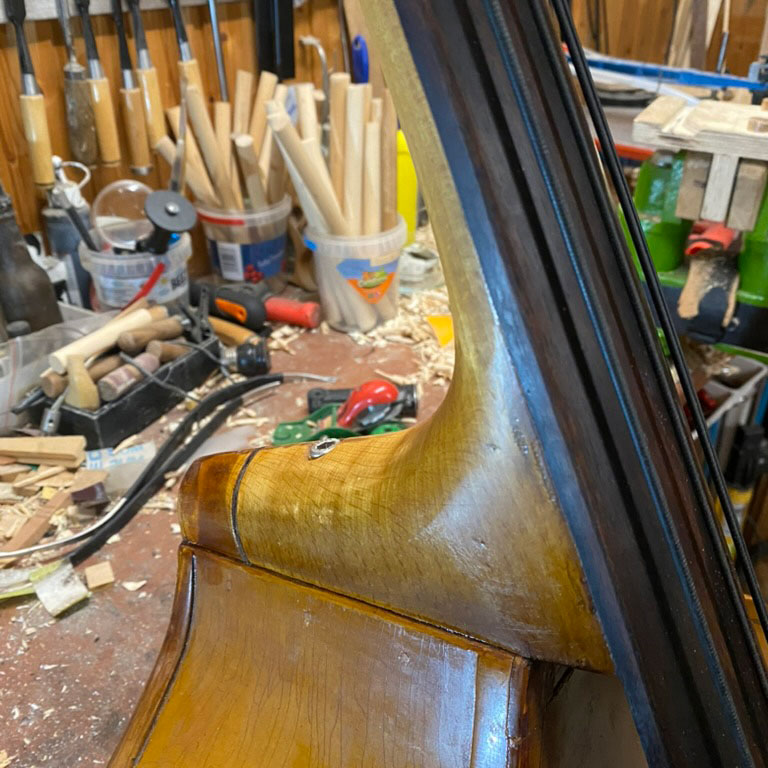
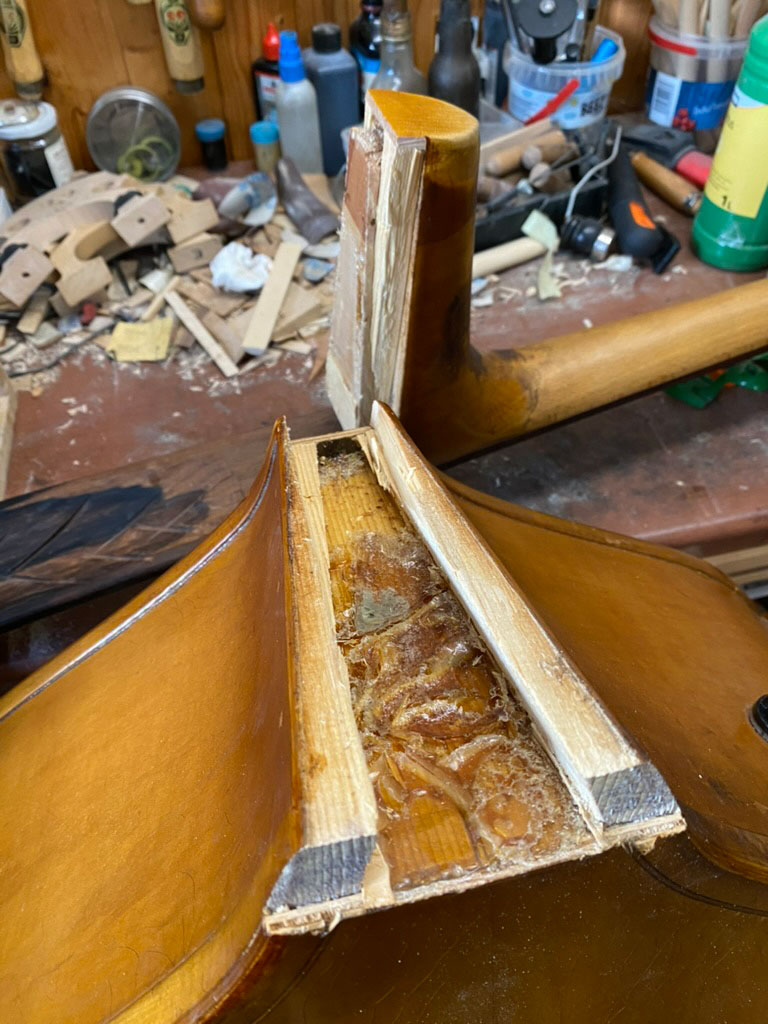
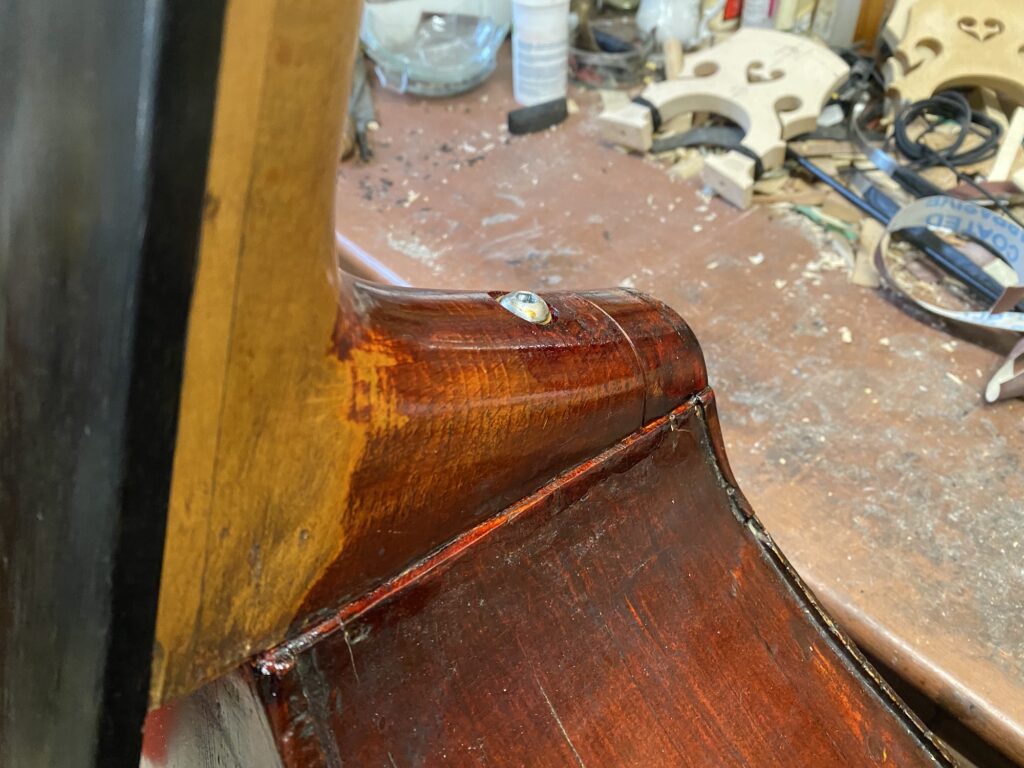
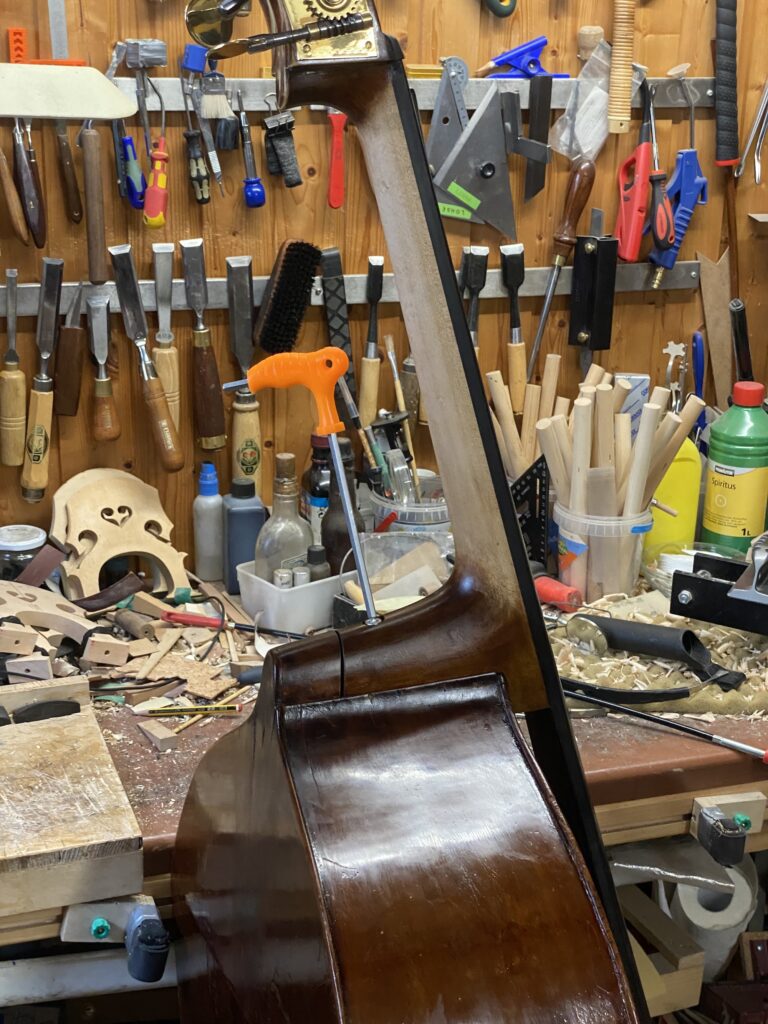
This neck joint had been repaired several times before… you can see the wooden dowels in the side that extended all the way to the base of the neck. Now the block had broken again.
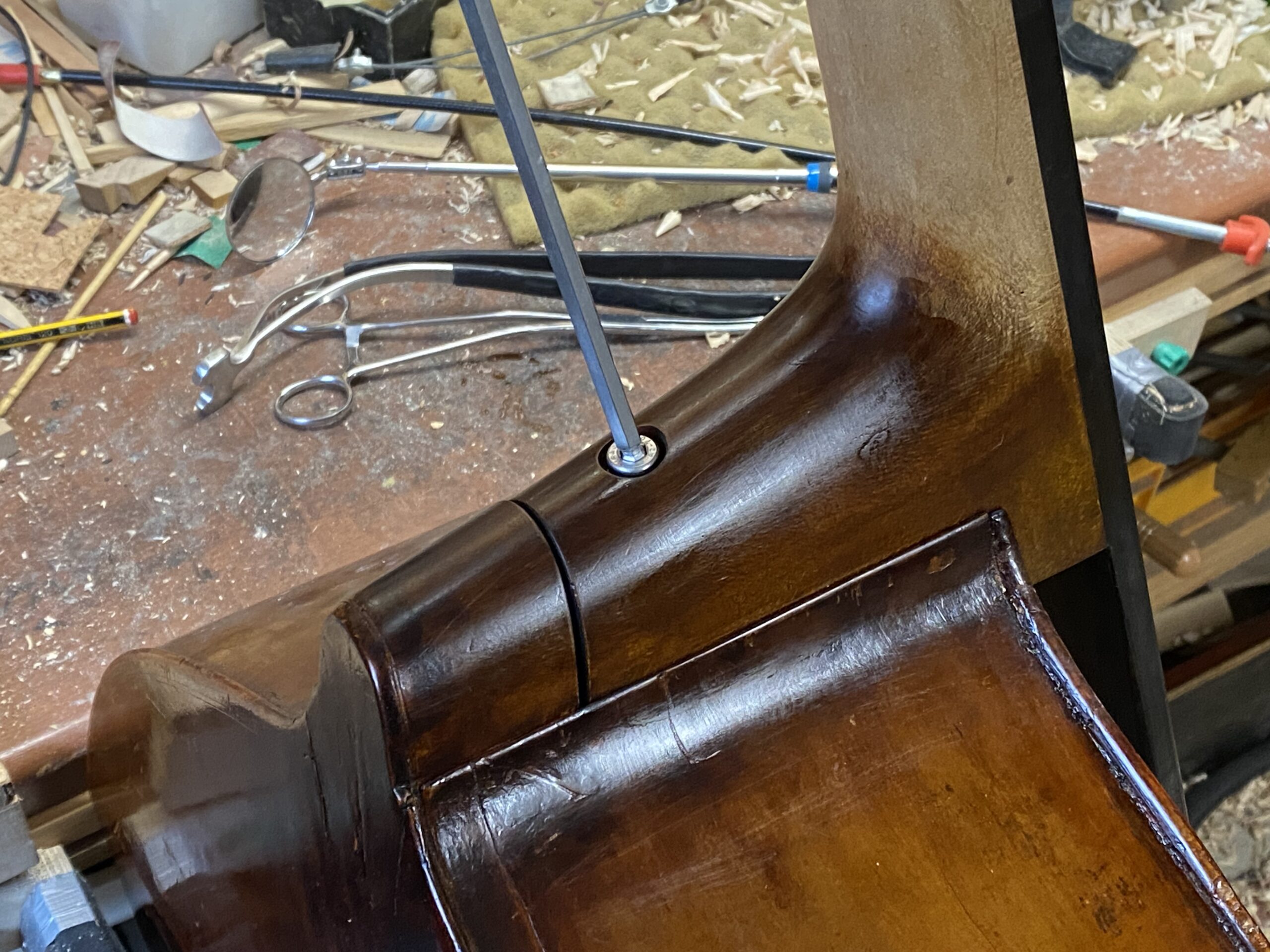
During this repair, I advised the customer to make the neck detachable—it has probably never been more secure than it is now, with the screw and the steel counter-thread mounted inside the block …
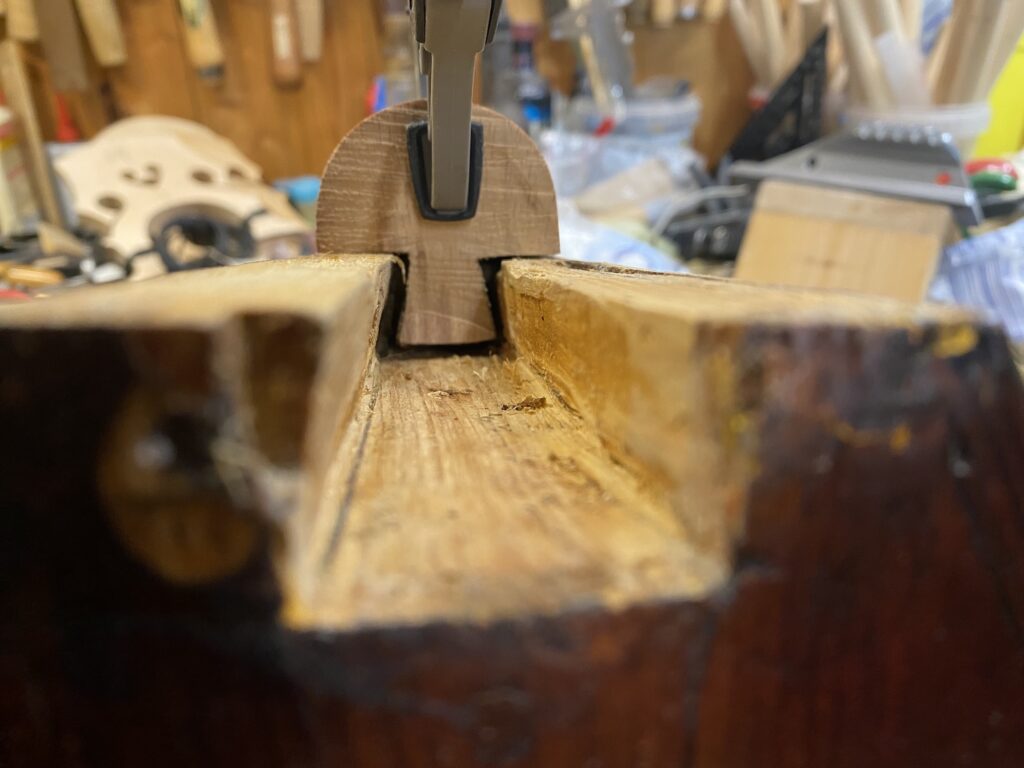
Hidden dovetail joints like this one are common on guitars, but they’re rarely found on basses—thankfully. They’re difficult to repair, and adjusting the neck angle or overhang is nearly impossible. This dovetail was also poorly executed—the button of the back (which had already been replaced) was bearing the brunt of the load, and there was a massive amount of glue under the neck heel that I first had to soak and wash out.
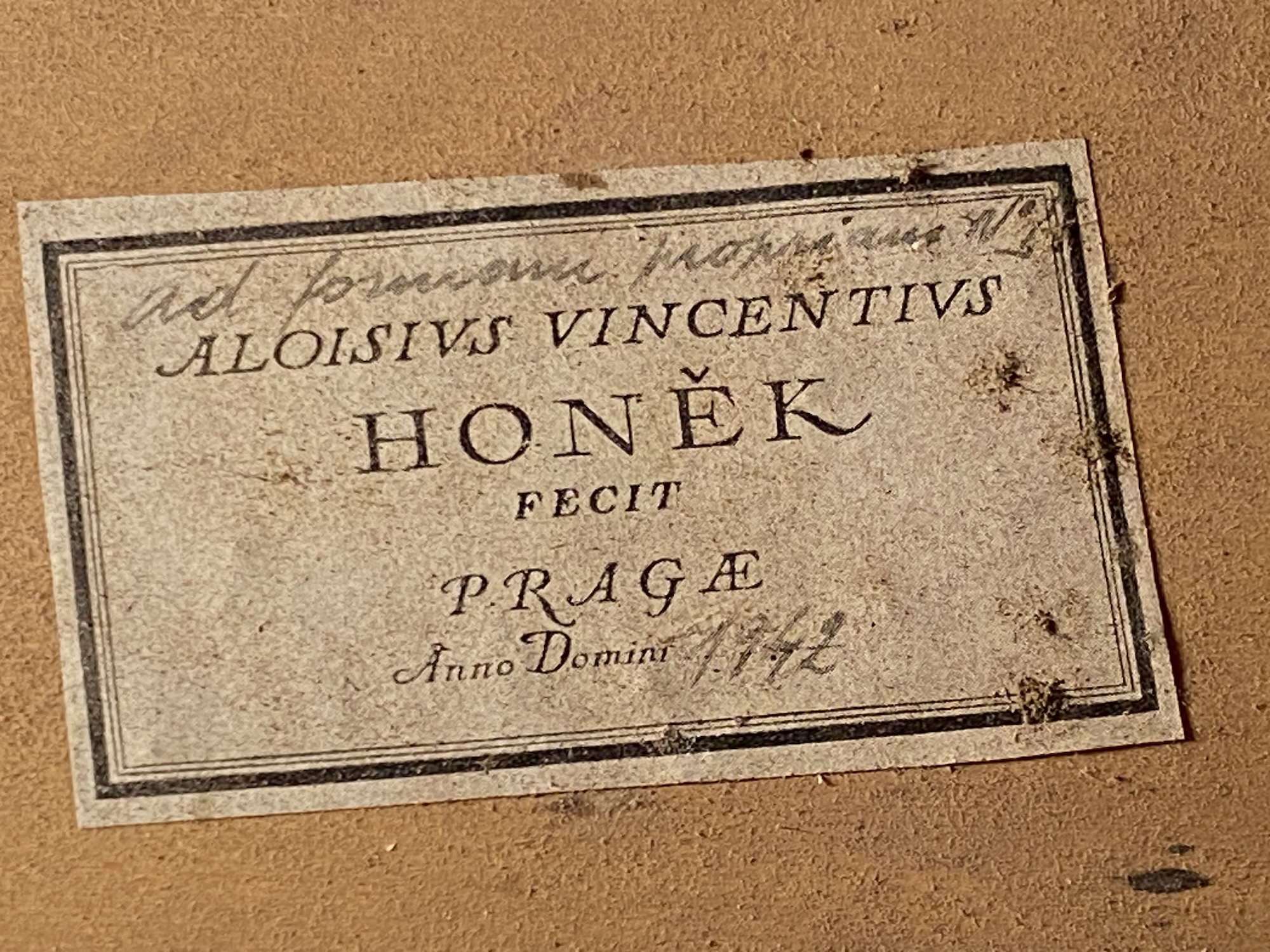
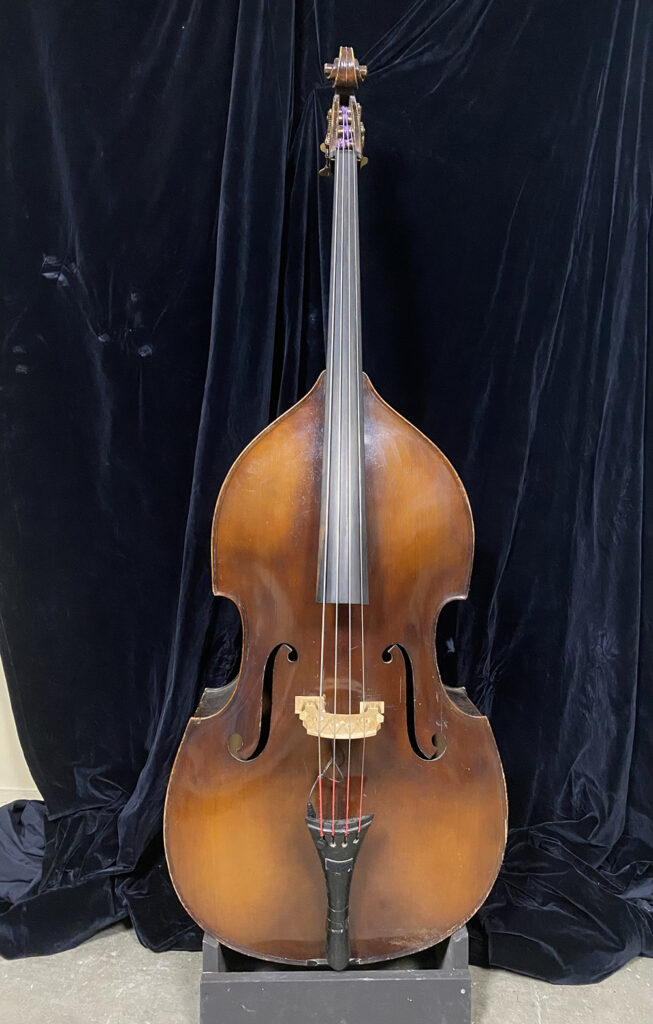
On my workbench: a double bass with a note from Alois Vincens Honek, on which, in addition to the year 1942, the following was handwritten: “ad formam propriam N. 3” (“based on his own design, No. 3”).
Well, this “own model” is certainly a bit unique: the bridge height is a substantial 18 mm. A standard blank usually has this height—before being adjusted, a process that inevitably results in some loss of height. So it’s a bit difficult to find a suitable blank. Otherwise, the bass is fairly simple: a solid spruce top, a domed plywood back, and a shaded spray finish in the style of that era.
The biography of violin maker Alois Honek is particularly noteworthy. He was born in 1911 in Děhylov (Silesia). His father was a carpenter who also made violins and passed this passion on to his son. While attending high school, he was trained as a violin maker by the Troppau-based violin maker Růžička, and graduated as a violin maker in 1929. After graduating from high school, however, he did not become a violin maker; instead, he enrolled at Charles University in Prague to study medicine. After successfully completing his studies, he decided to pursue a career as a surgeon.
Even as a doctor, he found enough time for his great passion: violin making. “He was known for working on his instruments as early as four in the morning. Only then would he set off on foot for the ‘Na Františku’ hospital, where he worked for many years as a senior physician,” his family recalls. He built over a hundred instruments, conducted research on optimizing the sound of violins, and published his findings in the renowned journal “The Strad.” And he certainly didn’t need a dictionary for the Latin texts in his violin scores. He was also considered an excellent surgeon who contributed to the advancement of his field. He maintained close ties with the Czech Philharmonic and accompanied the orchestra on its world tours—as a doctor and “healer” for the orchestra’s string instruments. Dr. Honěk died in 2002 at the age of 91.
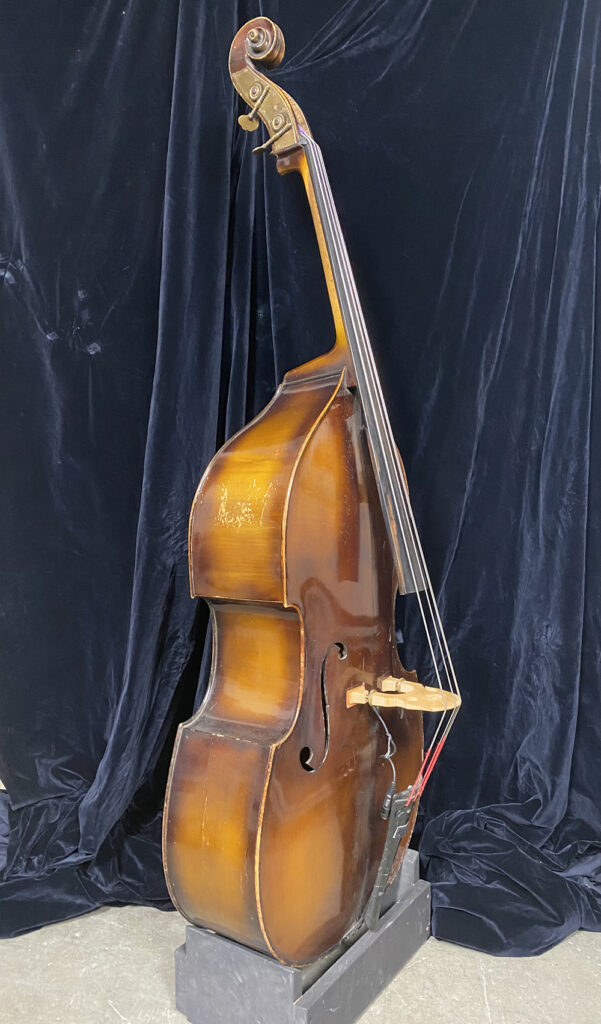
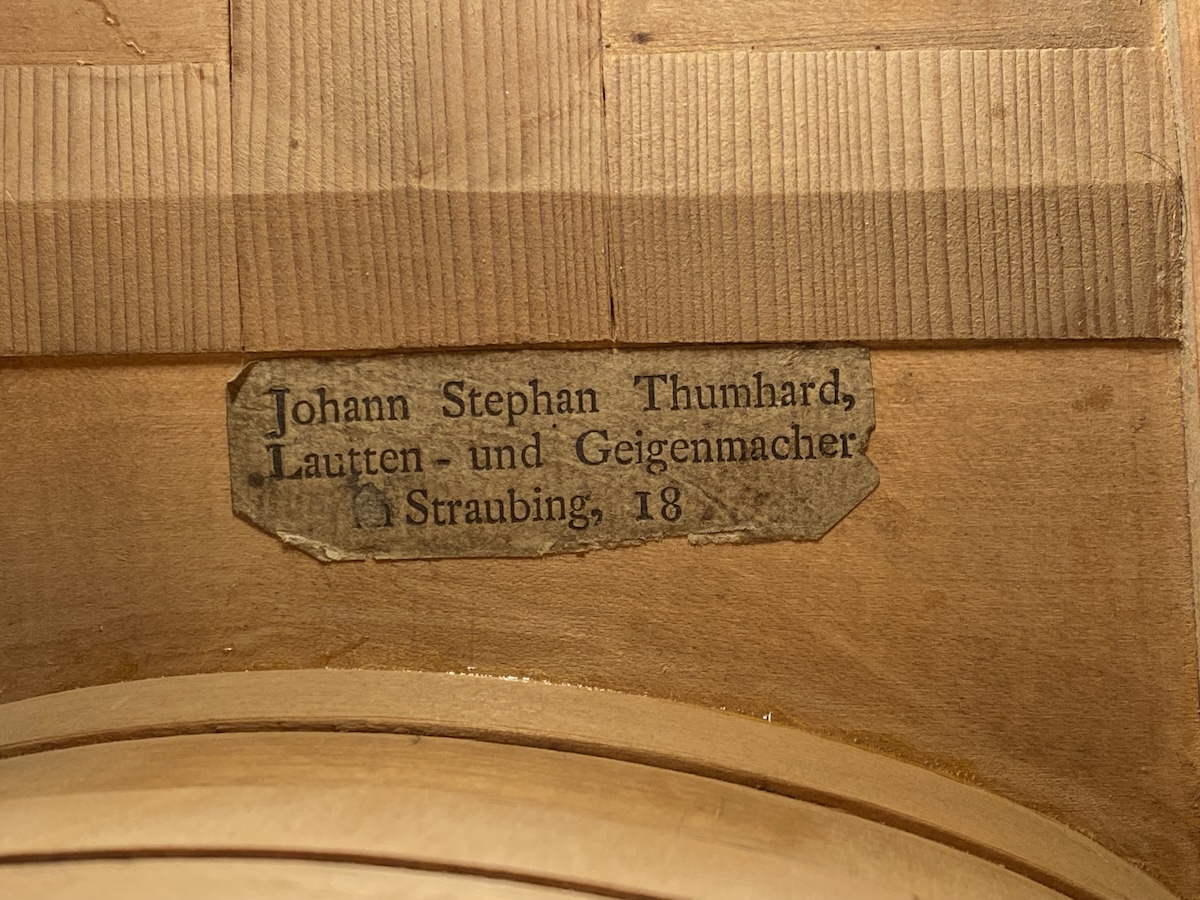
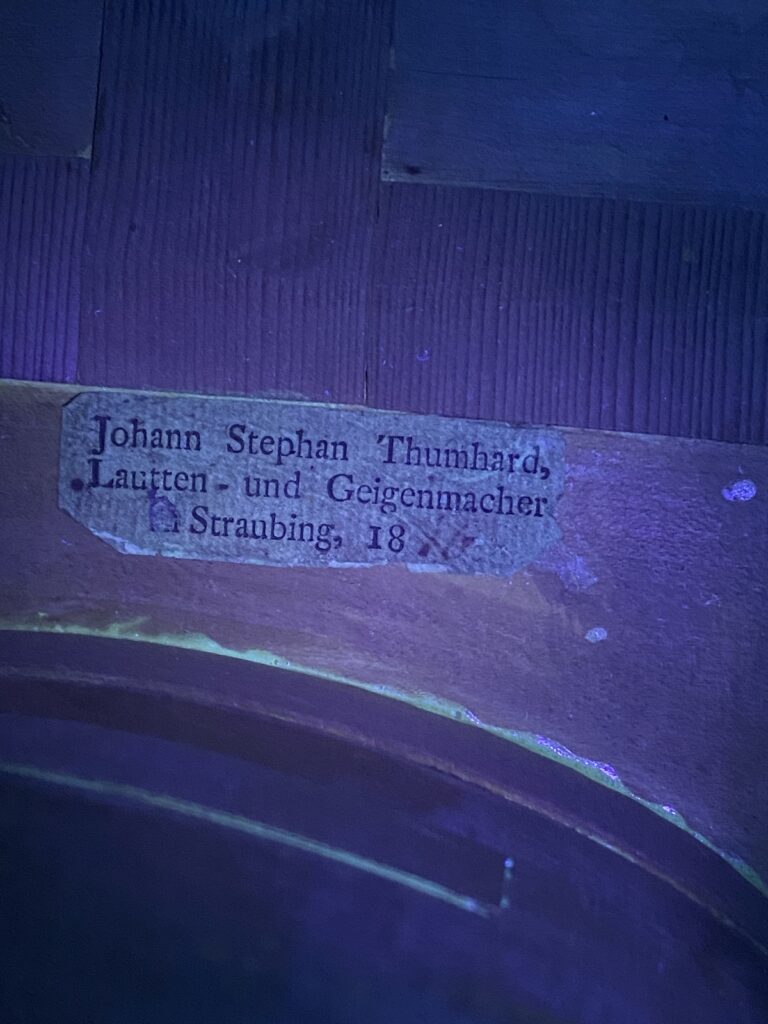
On my workbench today: half a bass with a note reading “Johann Stephan Thumhard.” The handwritten date is barely legible. A bit of UV light helps me make it out and reveals what might be a “16.” This suggests the bass was made a year before his death. The Thumharts (Dumbhart) were a large family of violin makers who lived and worked in Bavaria (Amberg, Straubing, Ingolstadt, Munich) during the 18th and 19th centuries. Lütgendorff writes about Johann Stephan Thumhard:
Thumhardt, Joh. Stephan — Straubing. *1749, † 26. Dezember 1817 According to the Straubing trade register, he established himself there in 1769 as a violin and string maker, married in 1773, and handed over his workshop and estate to his son Alois in 1817. He may have been a pupil of Buchstädter, whose work he imitated quite closely. His better violins display a characteristic narrow model with elongated scrolls and sound quite good; however, his brown-yellow or brown varnish has mostly lost its luster. His gravestone still stands in the St. Peter’s Cemetery in Straubing, and on it one reads: “He was esteemed by his fellow citizens, and posterity will still praise him for his works of art. R. J. P.” The twelve violins he allegedly made for a wealthy connoisseur and eccentric are considered his finest. For the first, he received one ducat, which seemed too little to him, yet he said nothing when he was immediately commissioned to make a second, even better one. The customer then paid two ducats for it and demanded an even better one, for which he paid three ducats, and so on up to twelve ducats. Because of their number—twelve—these violins are called “Apostle Violins”; one of them (from 1793) is still owned today by District Court Judge F. Ebner in Straubing. In the same collection is a viola from 1782; a viola from 1809 is owned by musician Schmid in Straubing. The church choir at St. Jakob there also owns two violins from 1814 and 1815, as well as a particularly beautiful bass (1815) by Stephan Th. His violins have already fetched quite good prices, and his basses even higher ones.
Height-adjustable double bass bridges are now widely used, and several bass makers have also experimented with adjustable necks. The goal here is to be able to adjust the string action (i.e., the distance between the strings and the fingerboard) in order to adapt the bass to varying humidity levels or different strings and playing requirements.
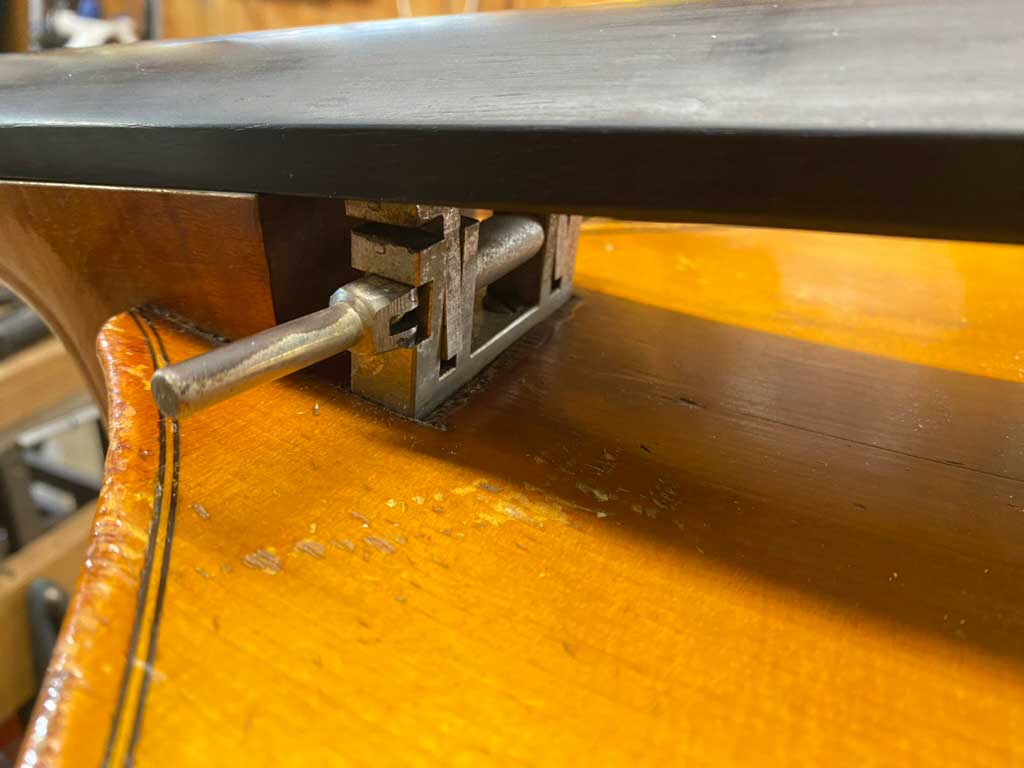
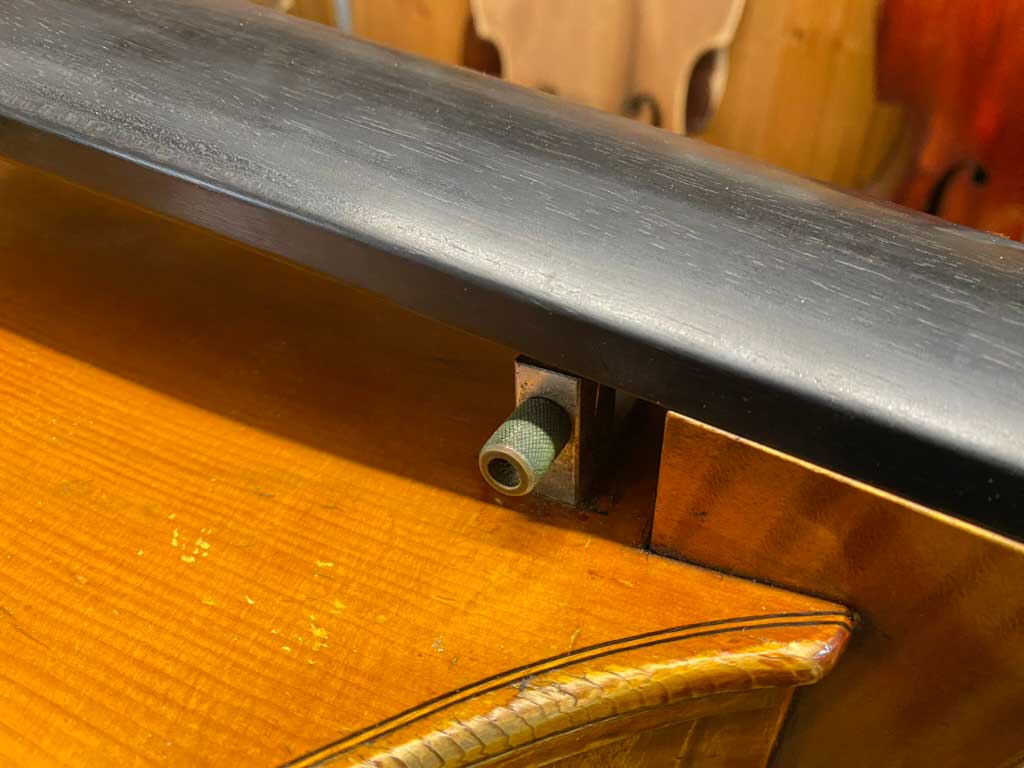
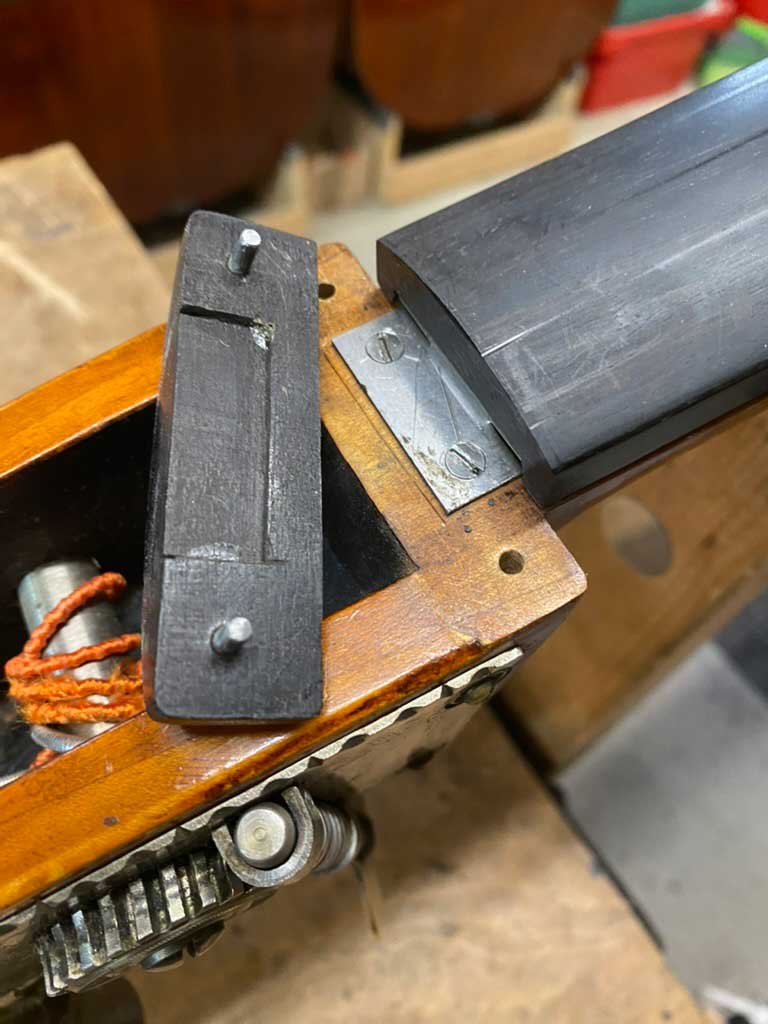
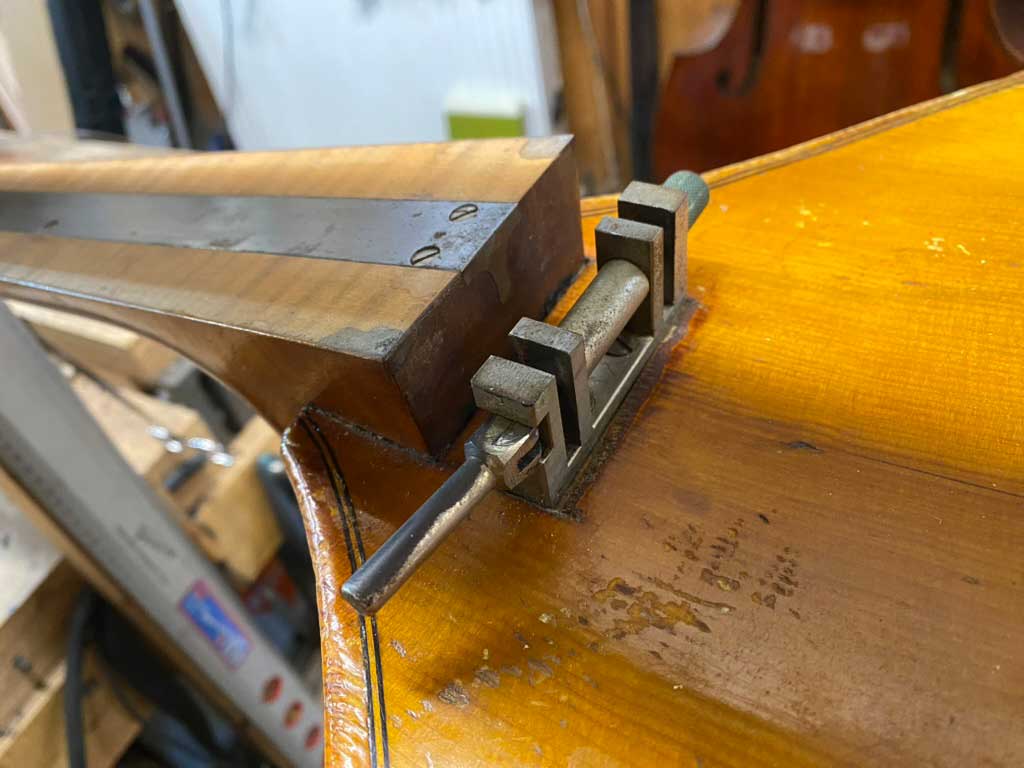
A customer recently brought me an interesting bass that had been fitted with a height-adjustable fingerboard (sic!) by the previous owner several decades ago. To achieve this, the fingerboard was screwed to the neck via a hinge beneath the nut. Beneath the fingerboard’s overhang, the angle of the fingerboard could be adjusted using a toggle lever. A stainless steel T-bar stabilized the neck, which would certainly have warped without the firmly glued fingerboard. Today, one would use a carbon insert here, but that material wasn’t available in the 1950s.
The whole design was very well executed from a craftsmanship standpoint—yet the customer still wanted it removed. Where the toggle clamp had been mounted on the neck block, I replaced the missing part of the top wood. The T-bar was not only screwed in but also glued—and could not be removed that easily. Milling it out was, of course, out of the question with stainless steel, as was applying significant force—so it stayed in place.
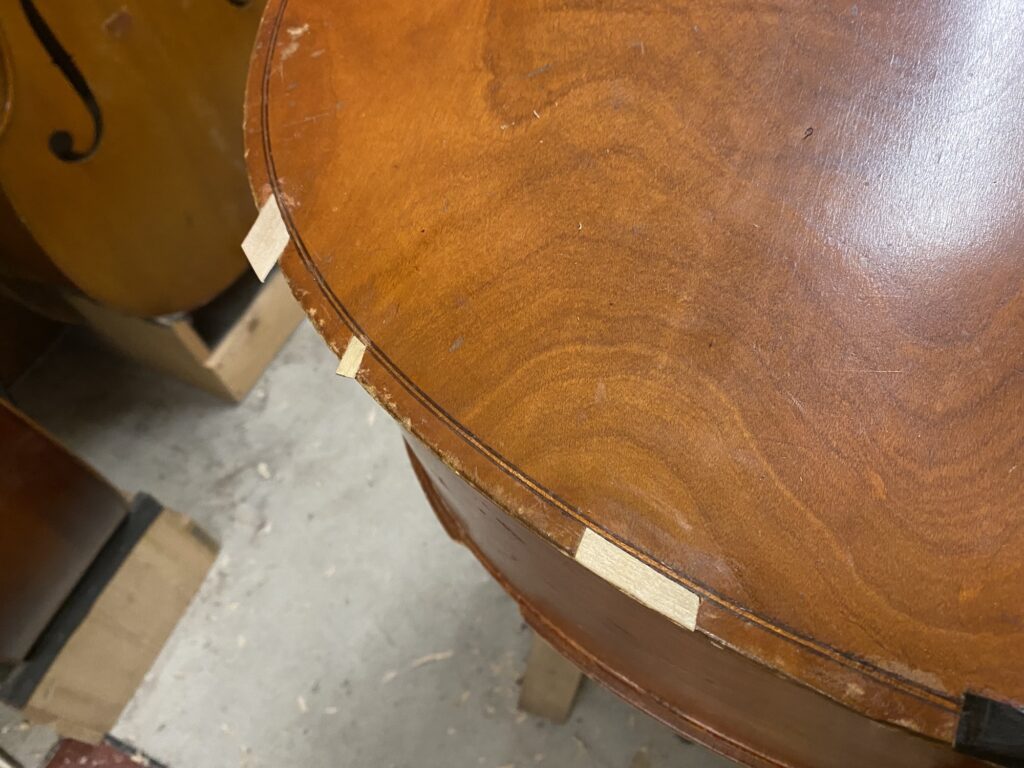
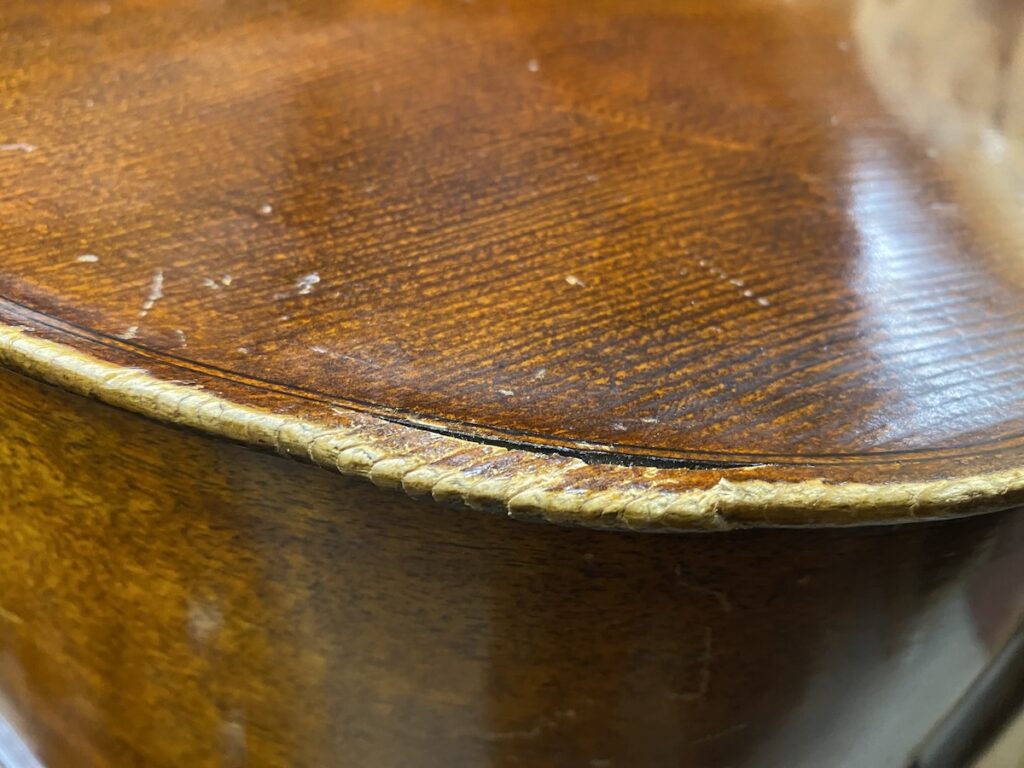
On double basses, the protruding edges of the top and back sometimes break off or splinter. On laminated double basses, this often only affects the outer layers of plywood.
On some basses, however, the purfling is merely painted on — especially plywood basses, but also many old Bohemian basses have no inlaid purfling. In violin-making literature, inlaid purfling is said to have a protective effect: cracks that run from the edge to the center are virtually “stopped” by the purfling running perpendicular. But is this really the case?
The plywood bass shown here clearly shows how the missing (and already replaced) pieces extend exactly to the inlaid purfling. Continuous cracks, which the purfling could stop, do not generally occur in plywood. But with some plywood basses, I have the impression that the narrow veneer edge splinters more easily precisely because the veneer has been cut through for the inserted chip. In that respect, this is not (only) a cost-saving workaround.
The situation is different with solid-wood basses (second photo). The edge was damaged and dented by an impact, and the wood has splintered along the grain. You can clearly see how the break ends at the purfling, and how this has helped to prevent the cracks from spreading further into the top. As no piece of wood was lost, this damage could be repaired very effectively.
This bass came to my workshop because the neck had come loose. After I removed it completely, it became clear that there was so much air in the glue joint that it couldn’t hold…
The neck joint on this bass is designed as a hidden dovetail joint, but it is so imprecise and has so much play that the glue joint to the back plate alone actually bore the entire load. We therefore decided to chenge the neck joint to a screwed connection. The reason for converting to a detachable neck was not easier travelling, but the screw promises to be the most durable connection here (a completely new and cleanly inserted neck was ruled out for cost reasons).
During the renovation, it became apparent that someone had already attempted to solve the problem of the loose neck with a screw: someone had screwed it in from above through the neck foot, but it was crooked from every angle. It eventually broke, and during another repair attempt, the screw hole was doweled again. However, the broken-off remainder of the screw is still stuck in the neck block.
After patching the dovetail joint, the neck is now securely held in place by an M8 screw—the counter thread was inserted into the neck block from the inside (bottom).
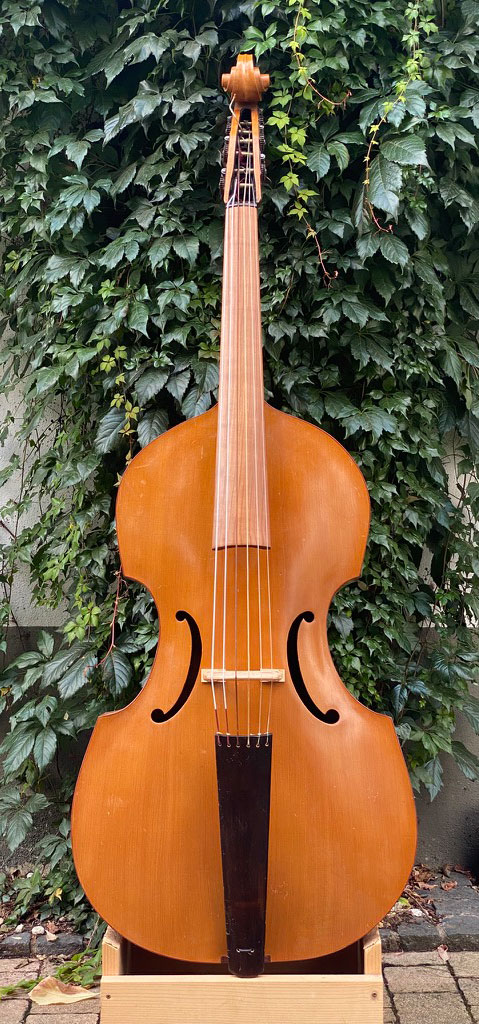
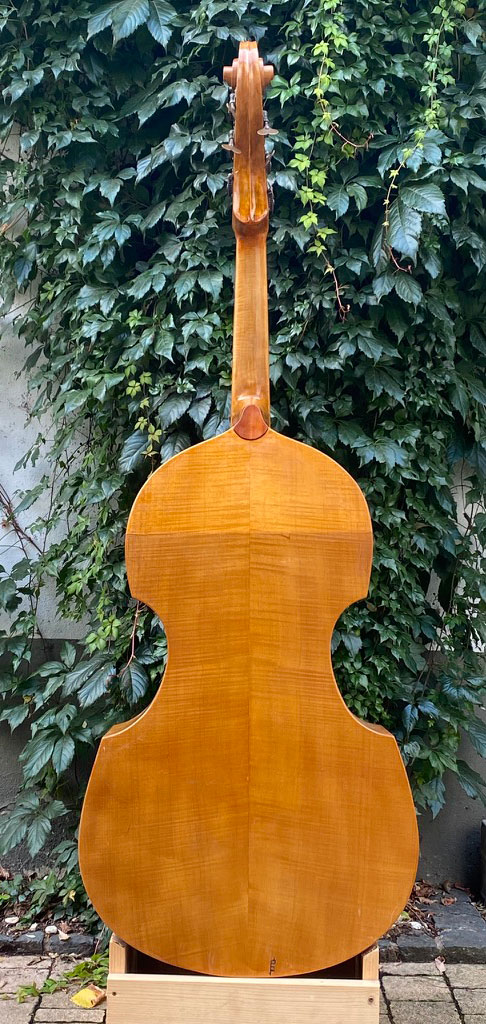
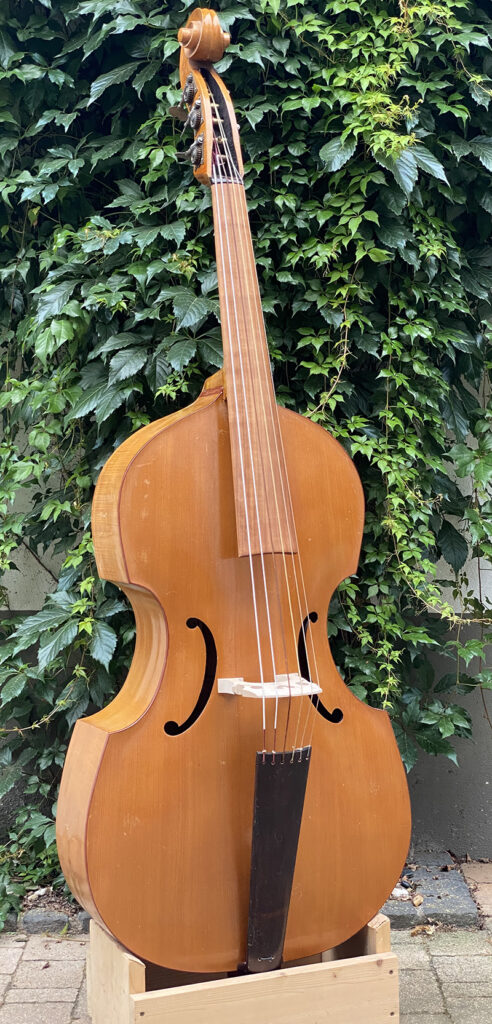
A double bass with six strings?!? No, a violone. This instrument, which belongs to the viola da gamba family, looks quite similar to a double bass, but the body is slightly larger than that of a ½ bass, while the scale length is slightly smaller at 90 cm. This G violone was built in 1962 by luthier Uebel in Celle/Germany. The tuning pegs are mounted in such a way that the direction of rotation of the pegs is the opposite of what you would expect from a bass. This means that you have to turn “downwards” to tune up. At first, I thought this was a mistake… something that can happen even to the most skilled instrument maker. However, I now assume that the tuning pegs were deliberately mounted this way so that the gut strings could be threaded over the pegs from below, rather than from above as is usually the case. This makes the angle at which the strings run over the nut slightly more acute, and the relatively thin and soft gut strings lie with a little pressure on the nut. The fairly wide notches in the original saddle indicate to me that the strings were previously strung in this way.
Sie interessieren sich für unser Sortiment und möchten etwas bestellen? Schreiben Sie uns gerne per E-Mail, oder kommen Sie einfach mal bei uns in Frankfurt vorbei!
Please send us an e-mail if you require further information or would like to order something. Or simply drop by our shop in Frankfurt!
Zustimmung verwalten
Um dir ein optimales Erlebnis zu bieten, verwenden wir Technologien wie Cookies, um Geräteinformationen zu speichern und/oder darauf zuzugreifen. Wenn du diesen Technologien zustimmst, können wir Daten wie das Surfverhalten oder eindeutige IDs auf dieser Website verarbeiten. Wenn du deine Zustimmung nicht erteilst oder zurückziehst, können bestimmte Merkmale und Funktionen beeinträchtigt werden.
Funktional
Always active
Die technische Speicherung oder der Zugang ist unbedingt erforderlich für den rechtmäßigen Zweck, die Nutzung eines bestimmten Dienstes zu ermöglichen, der vom Teilnehmer oder Nutzer ausdrücklich gewünscht wird, oder für den alleinigen Zweck, die Übertragung einer Nachricht über ein elektronisches Kommunikationsnetz durchzuführen.
Vorlieben
Die technische Speicherung oder der Zugriff ist für den rechtmäßigen Zweck der Speicherung von Präferenzen erforderlich, die nicht vom Abonnenten oder Benutzer angefordert wurden.
Statistiken
Die technische Speicherung oder der Zugriff, der ausschließlich zu statistischen Zwecken erfolgt.Die technische Speicherung oder der Zugriff, der ausschließlich zu anonymen statistischen Zwecken verwendet wird. Ohne eine Vorladung, die freiwillige Zustimmung deines Internetdienstanbieters oder zusätzliche Aufzeichnungen von Dritten können die zu diesem Zweck gespeicherten oder abgerufenen Informationen allein in der Regel nicht dazu verwendet werden, dich zu identifizieren.
Marketing
Die technische Speicherung oder der Zugriff ist erforderlich, um Nutzerprofile zu erstellen, um Werbung zu versenden oder um den Nutzer auf einer Website oder über mehrere Websites hinweg zu ähnlichen Marketingzwecken zu verfolgen.