This bass arrived at our workshop with a nasty crack in the top. Fortunately, no pieces were lost during transport; we only had to carve and replace a few small splinters. Just one week after the accident, the instrument was back on stage …
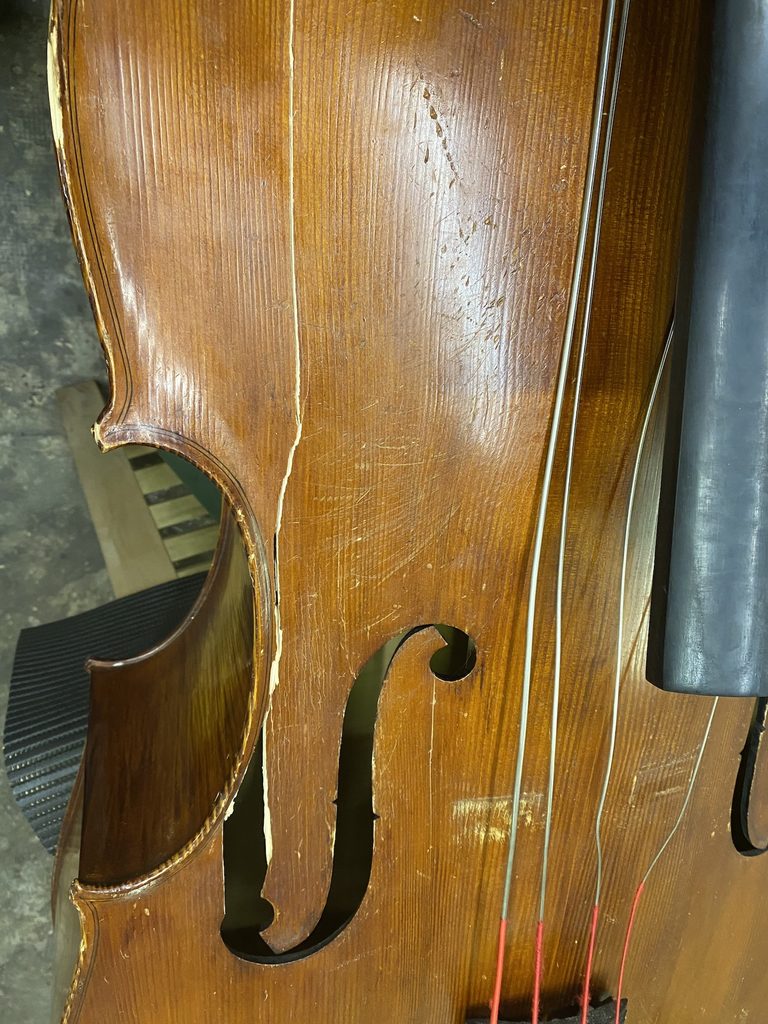
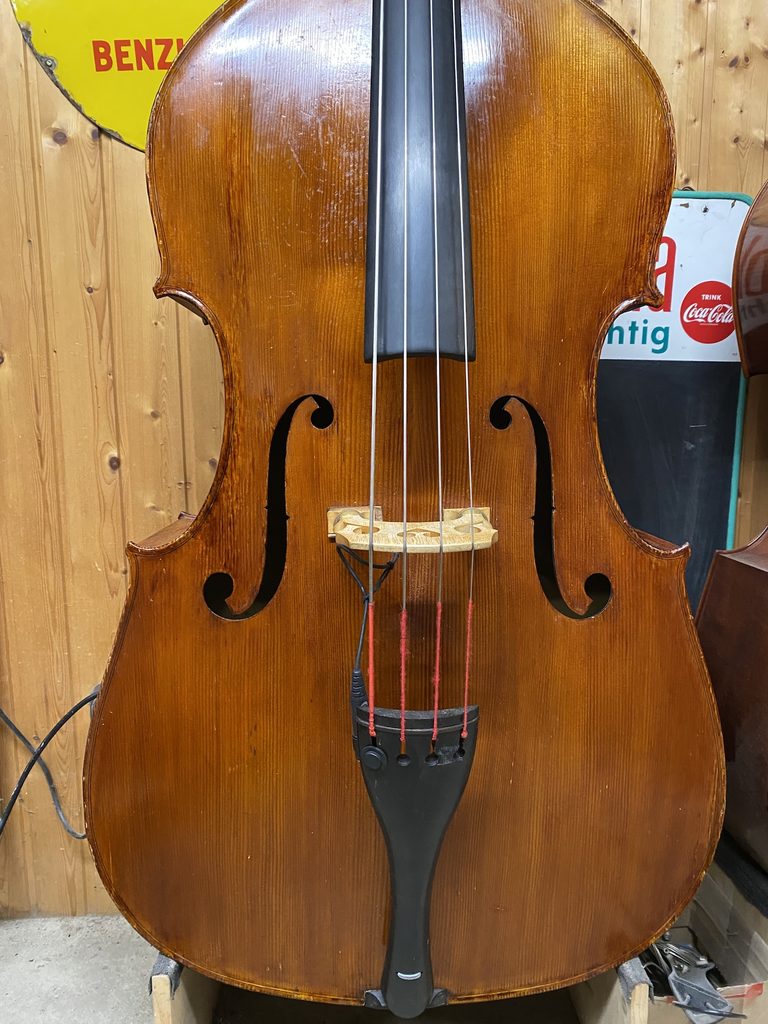
This bass arrived at our workshop with a nasty crack in the top. Fortunately, no pieces were lost during transport; we only had to carve and replace a few small splinters. Just one week after the accident, the instrument was back on stage …
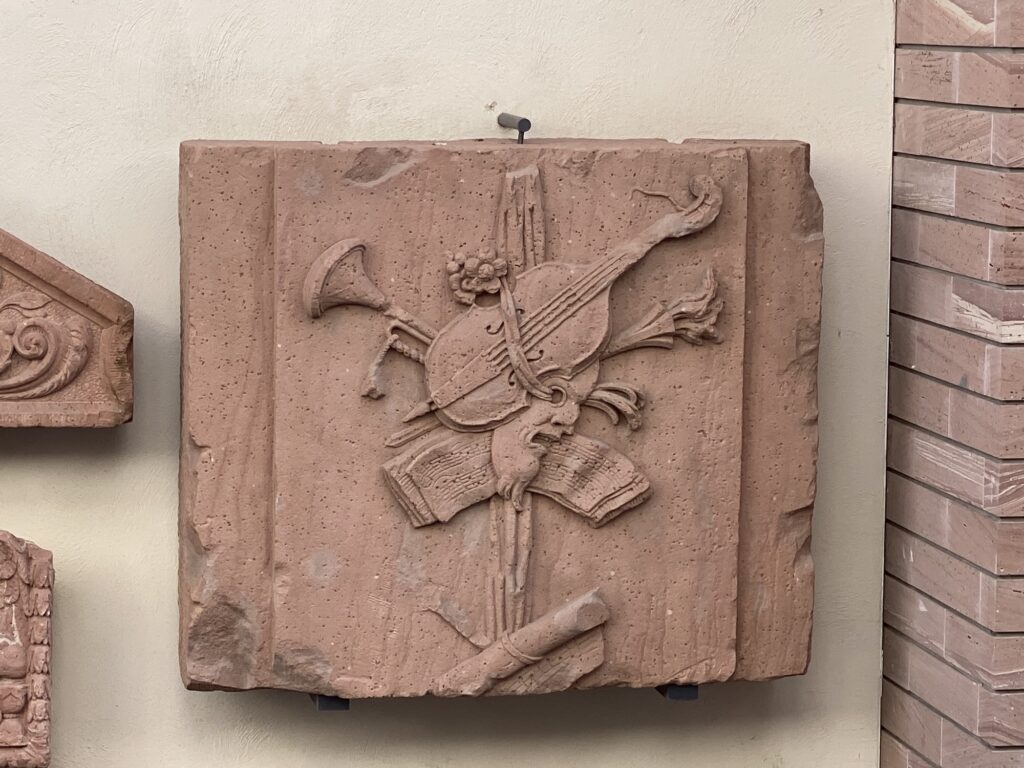
I spotted this beautiful relief on the outer wall of the Frankfurt Historical Museum
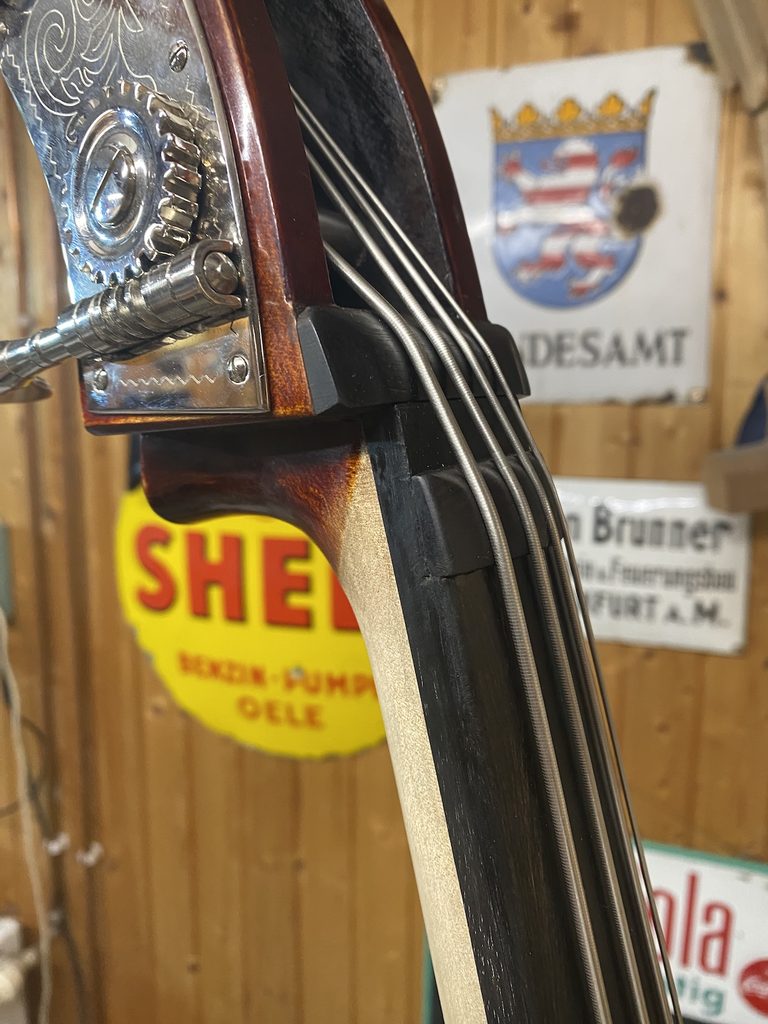
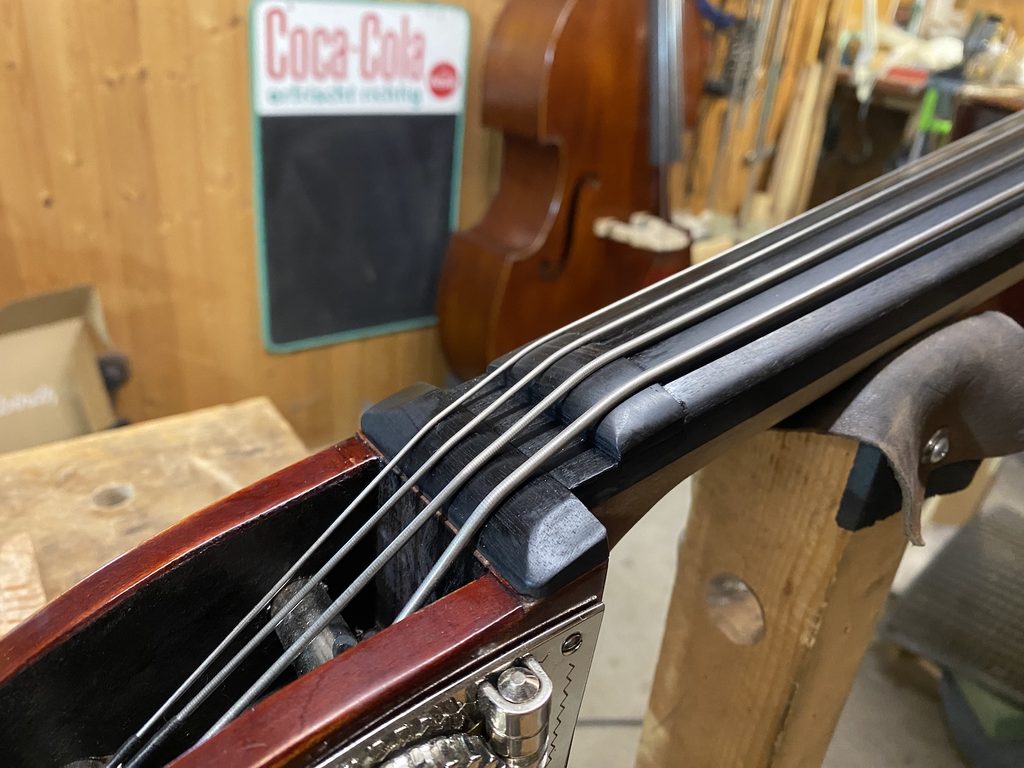
Some basses have an unwieldy long string length. As you can’t simply move the bridge, the only real way to change this is by fitting a new neck – or by using what is known (in Germany) as an ‘English nut’.
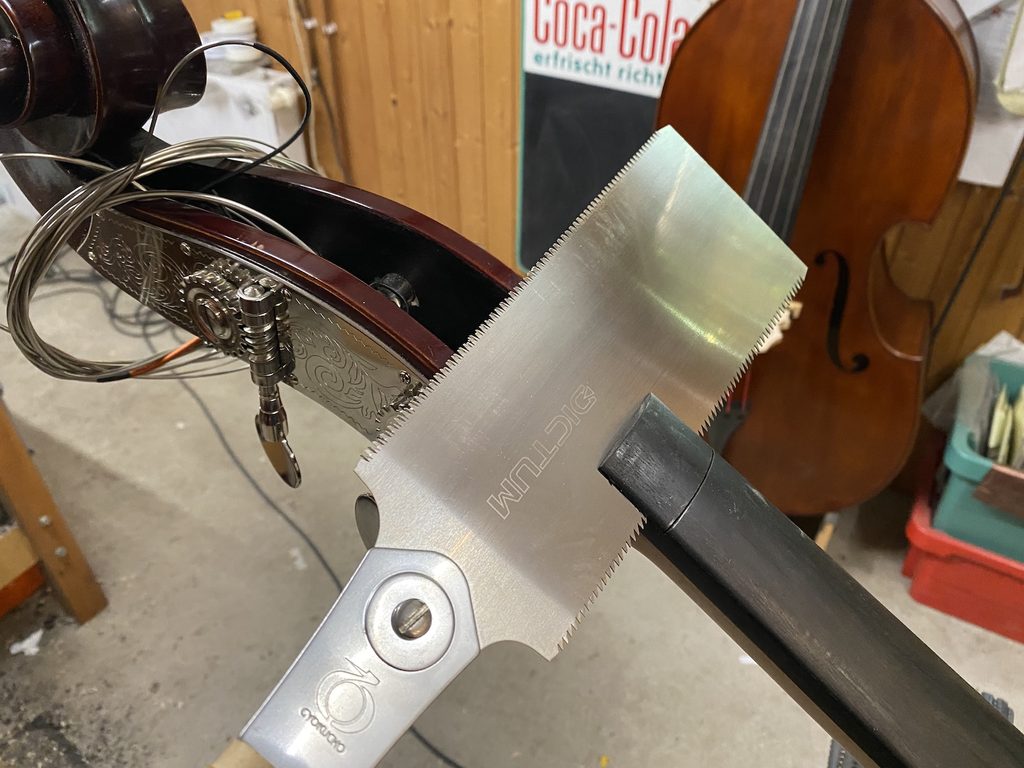
The English nut shortens the playable string length from the pegbox. To achieve this, the fingerboard is shortened so that the upper nut is moved downwards.
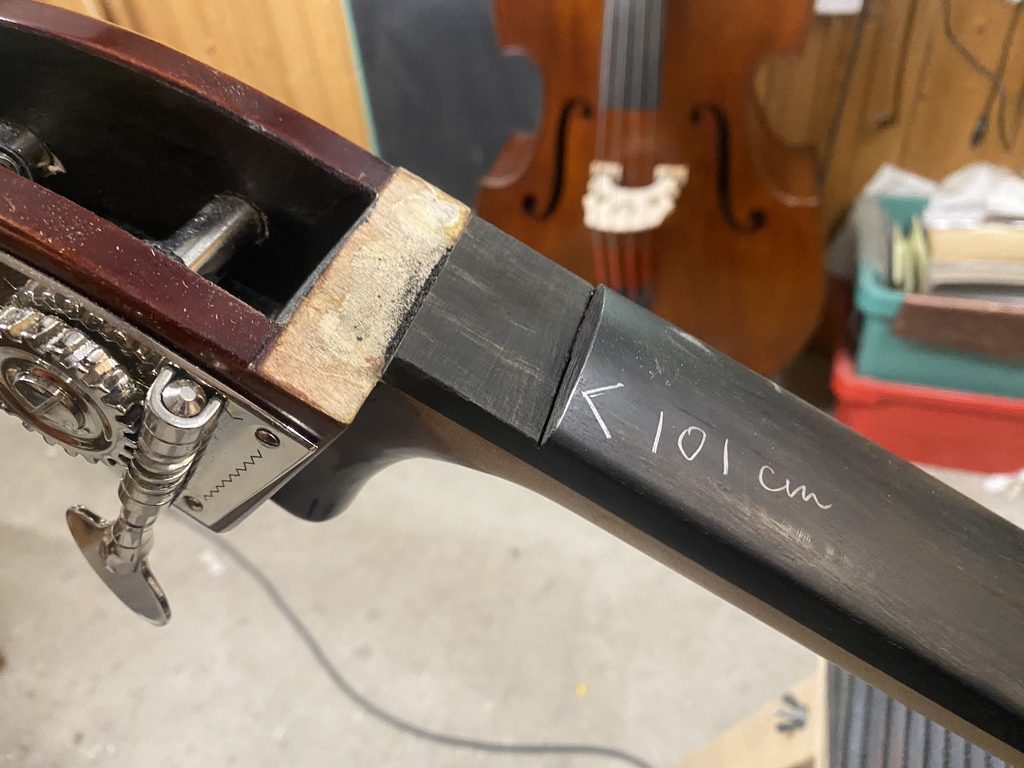
This bass actually already had a comfortable string length of 104 cm – but the customer wanted 101 cm. To achieve this, I didn’t shorten the fingerboard completely, but instead cut out a step on which the new nut sits.
Naturally, the English saddle and the shortened scale length have also changed the position of all the notes on the fingerboard. So, to restore a D scale length, I also carved away a bit of wood at the base of the neck and rounded everything off nicely: now the D note played on the G string is once again opposite my ‘locked-in’ thumb.
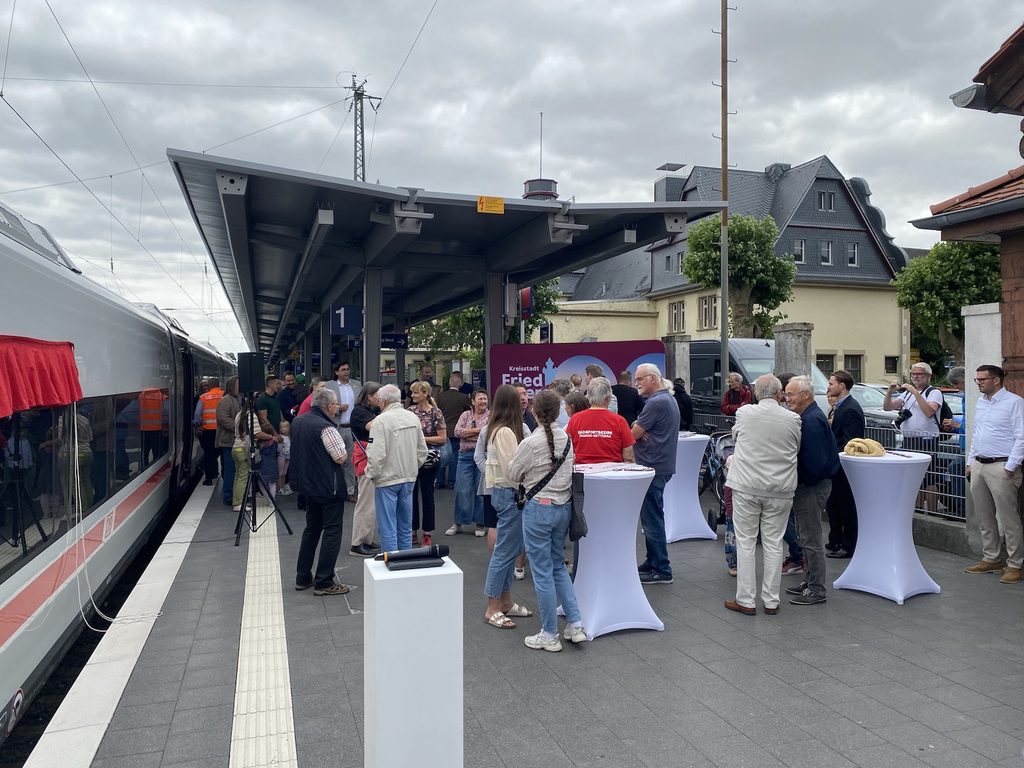
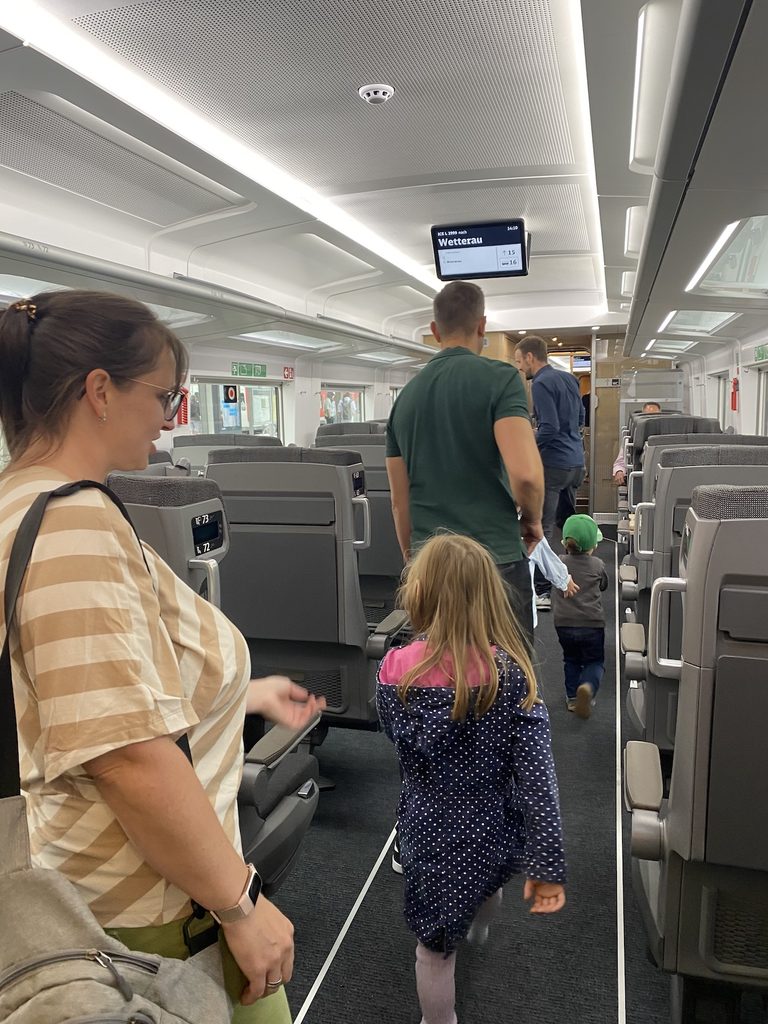
A month ago, the new ICE L (high speed train) made its first stop at Friedberg (where our workshop is located) – and it was an unscheduled one: it was officially christened ‘Wetterau’ in our district town. I was invited to the event and took the opportunity to inspect the new train model from the Spanish manufacturer Talgo straight away to see if it could accommodate a double bass.
My impression: well … DB’s new ICE model is accessible, but it’s significantly slower and far less spacious than its predecessors. I reckon there’s even more space on the Regional Express!
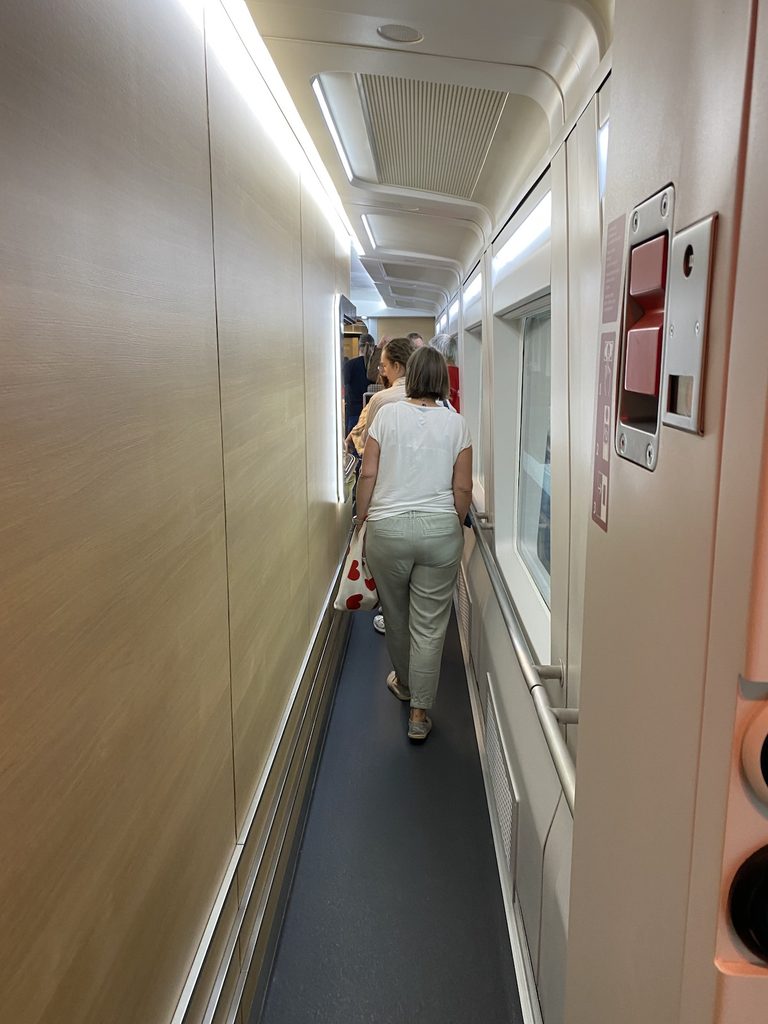
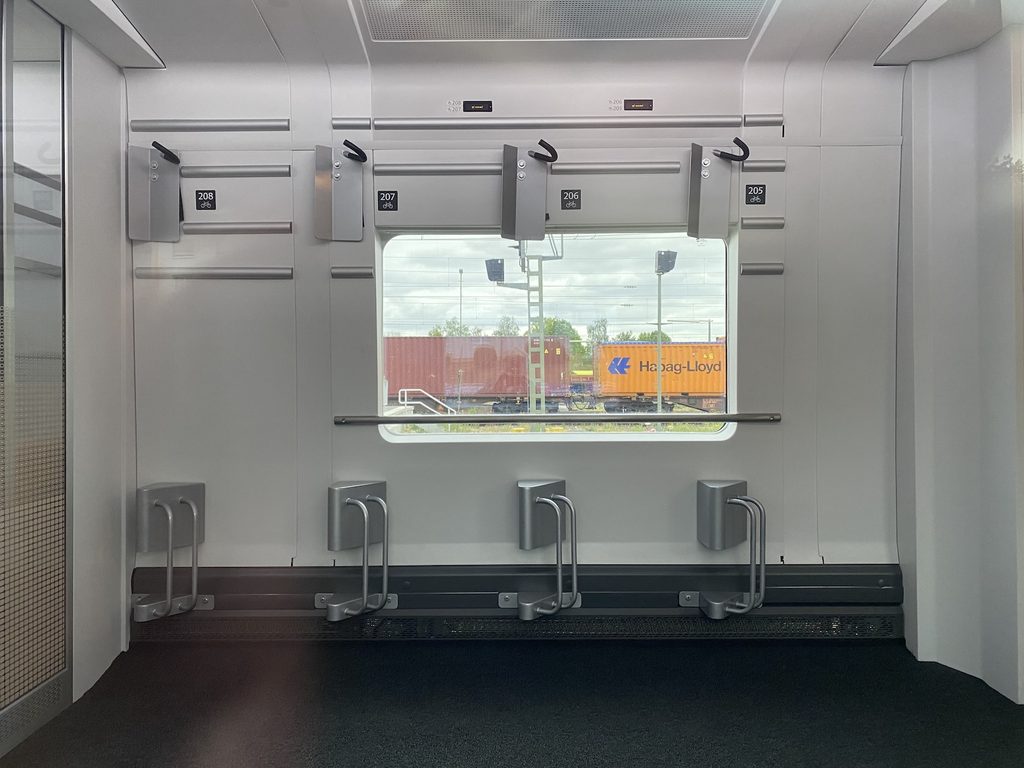
In the main compartments, storing luggage is likely to be rather tricky in general – I couldn’t spot a suitable space for a double bass there. However, the ICE-L has a bicycle compartment that can hold eight bikes. It was locked during the launch event, but I did have a peek inside from the outside. It seems to me to be the only realistic storage option for the double bass, provided you can come to an agreement with the cyclists who have paid for spaces there.
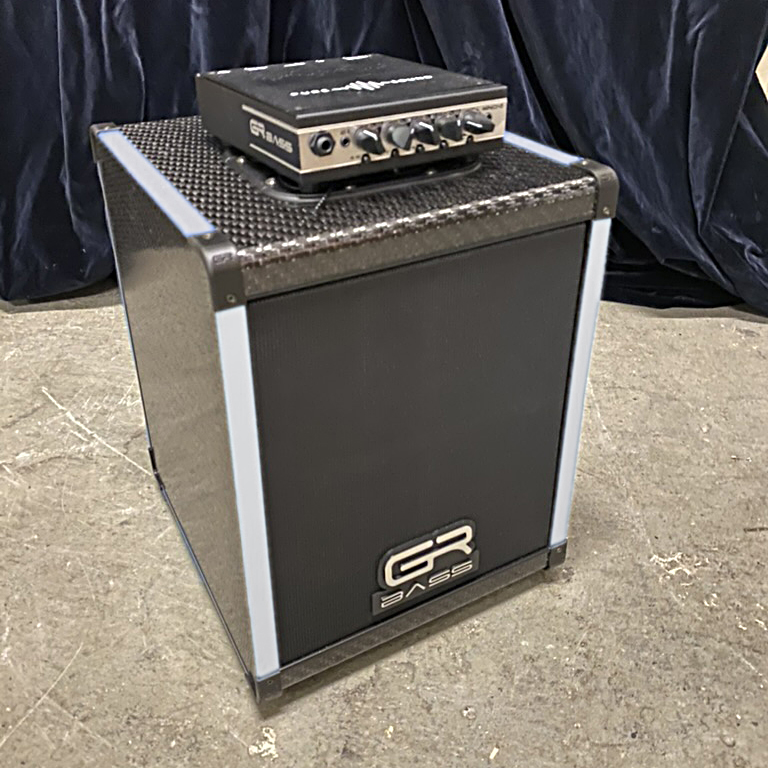
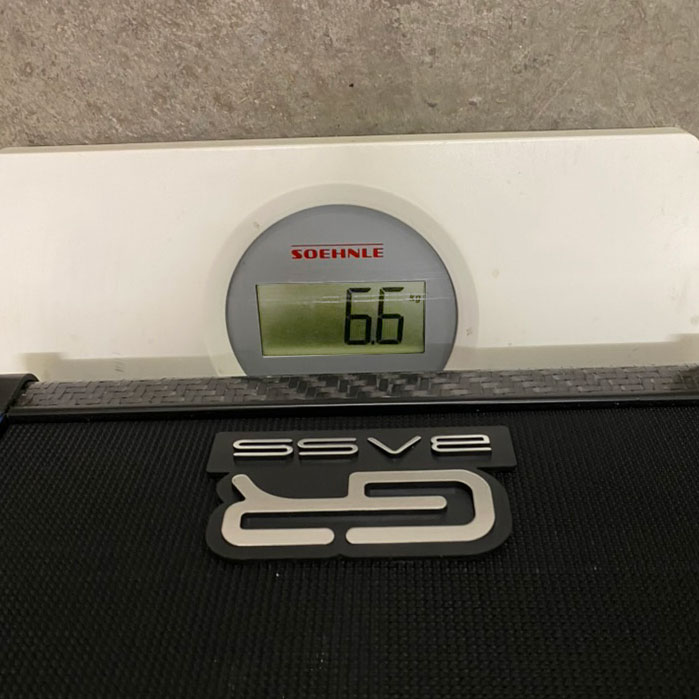
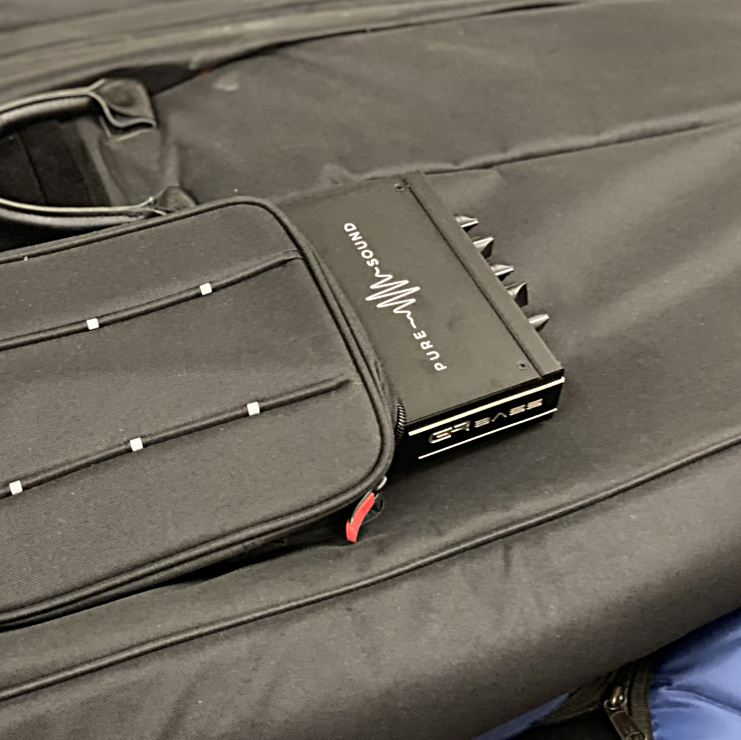
GR Bass has something for (or rather, against) bassists’ aching backs! 6.6 kg – that’s the combined weight of the speaker, amp and cables. That’s half the weight of some double basses. The amp head is so compact that it even fits inside a double bass case. The speaker cabinet is made of carbon fibre and can literally be lifted with your little finger.
There are 1,288 ‘specialist music retailers’ in Germany – and we, as the Kontrabass-Atelier double bass workshop, are one of them. Whilst the sector’s total turnover rose by 17 per cent between 2020 and 2024, this turnover is being shared amongst an ever-smaller number of market players.
In 2024, there were nine specialist retailers in Germany with an annual turnover of more than 10 million Euros – these nine accounted for 0.7 per cent of all specialist retailers. And in 2024, this group – comprising less than 1 per cent of retailers – accounted for over 70 per cent of turnover, with the trend set to rise. And whilst turnover rose overall, small and medium-sized retailers (i.e. those with an annual turnover of between 100,000 and 5 million euros) collectively recorded a fall in turnover of 19 million Euros, or just under 5 per cent – accompanied by a 1 per cent decline in the number of businesses.
There are also significant regional differences; music retailers are distributed very unevenly across the federal states. In Mecklenburg-Western Pomerania, there are (were?) just seven companies, whilst in Bavaria there are still 290 businesses, including the world’s highest-turnover music retailer, which alone (!) generates 1.53 billion Euros in annual turnover.
However, the group of smaller retailers is also very diverse: “The high proportion of businesses with an annual turnover of less than 100,000 Euros (2024: 39 % of all businesses) suggests that many professional and amateur musicians work as retailers on a part-time basis and have applied for a trading licence for this purpose, which means they are recorded in the statistics as taxable businesses,” says the MIZ (Music Information Centre), explaining the figures from the Federal Statistical Office.
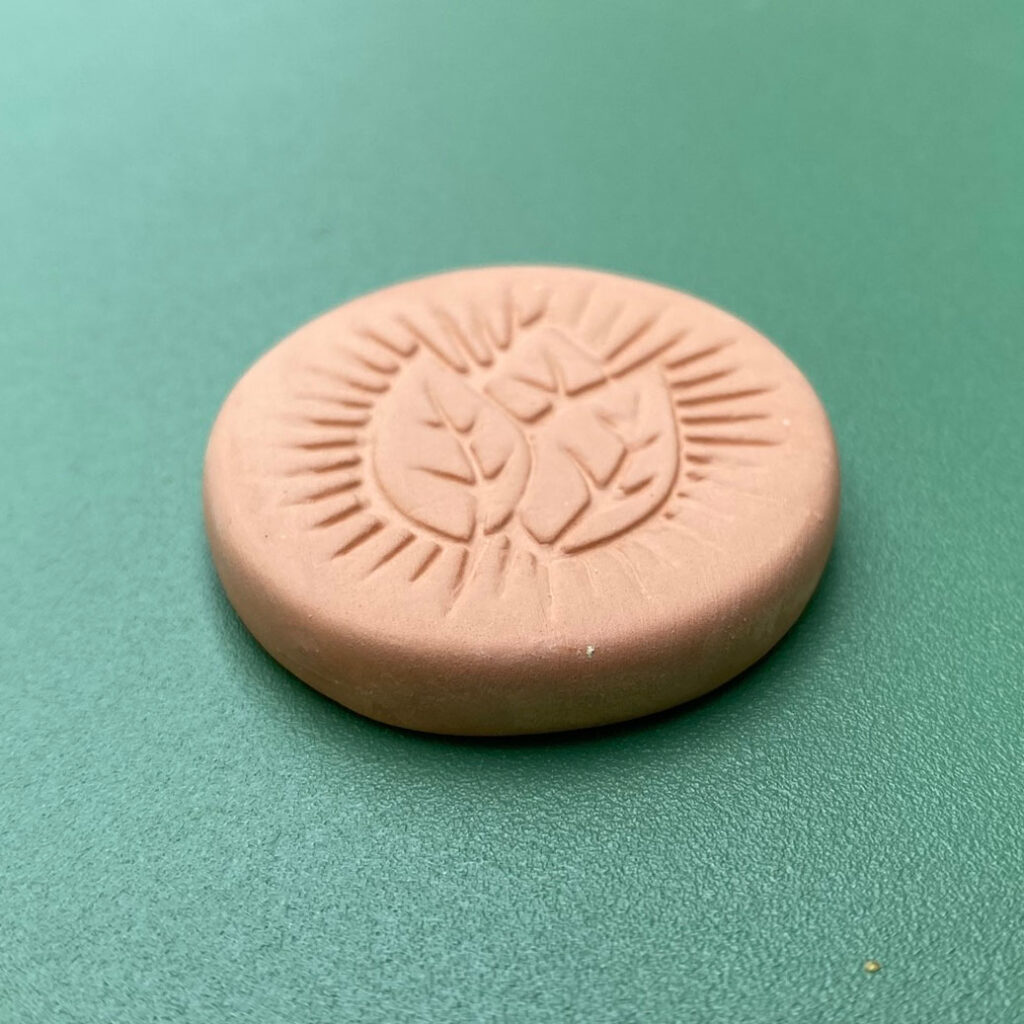
Rosin ages as it dries out. To keep it pliable, you need to ensure it has enough moisture—which isn’t so easy, because if rosin absorbs too much moisture, it becomes “mushy.”
Smokers face the same problem with tobacco. For cigars, small pouches containing a gel-like substance are available to help regulate humidity. Products like the “Rosin Saver” also use these pouches.
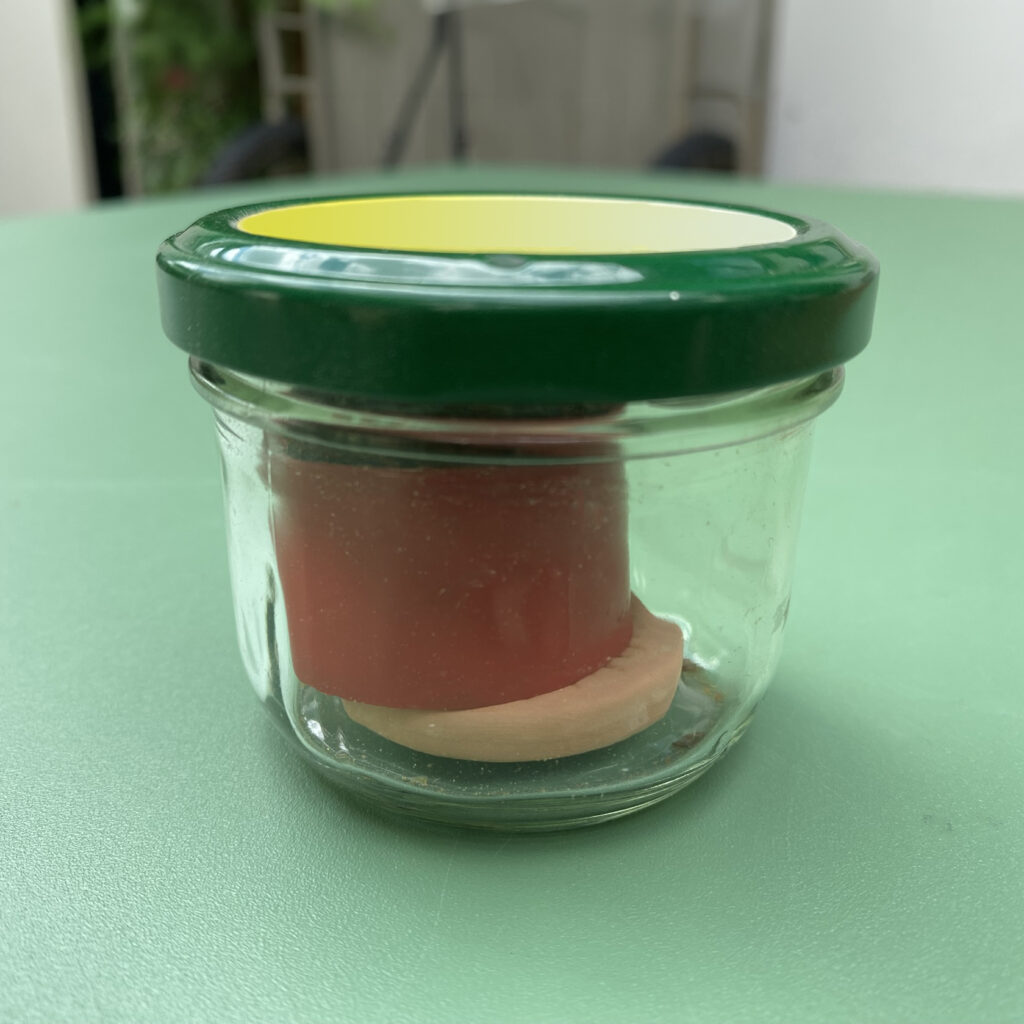
Small clay discs are more sustainable (because they can be reused). Soak them in water for a few minutes until they are fully saturated. Then remove them, pat them dry, and place them in a screw-top jar along with the rosin (a jar of horseradish paste, for example, is a good size).
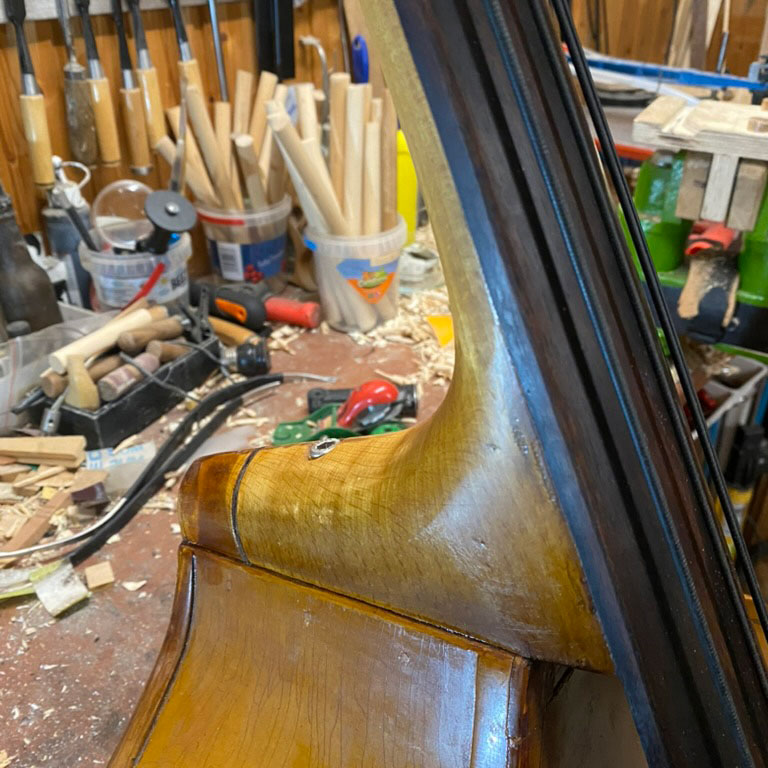
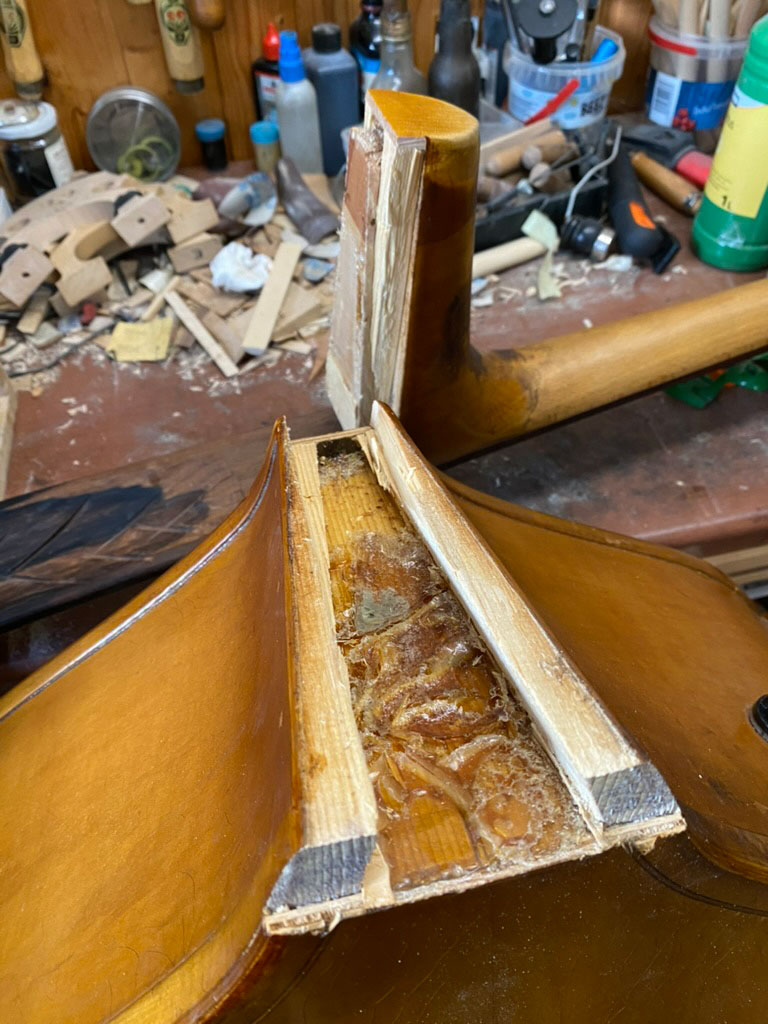
This neck joint had been repaired several times before… you can see the wooden dowels in the side that extended all the way to the base of the neck. Now the block had broken again.
During this repair, I advised the customer to make the neck detachable—it has probably never been more secure than it is now, with the screw and the steel counter-thread mounted inside the block …
Hidden dovetail joints like this one are common on guitars, but they’re rarely found on basses—thankfully. They’re difficult to repair, and adjusting the neck angle or overhang is nearly impossible. This dovetail was also poorly executed—the button of the back (which had already been replaced) was bearing the brunt of the load, and there was a massive amount of glue under the neck heel that I first had to soak and wash out.
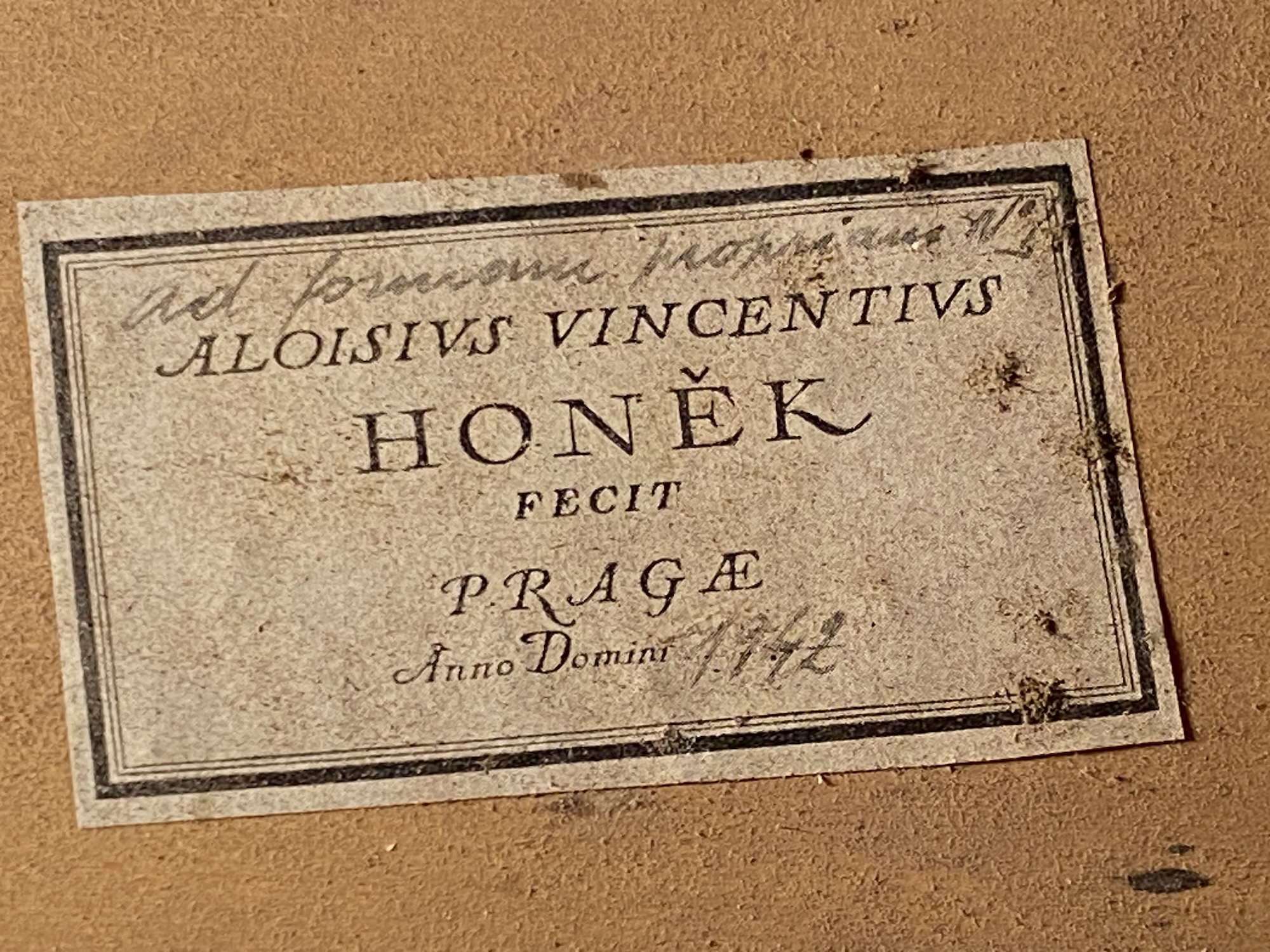
On my workbench: a double bass with a note from Alois Vincens Honek, on which, in addition to the year 1942, the following was handwritten: “ad formam propriam N. 3” (“based on his own design, No. 3”).
Well, this “own model” is certainly a bit unique: the bridge height is a substantial 18 mm. A standard blank usually has this height—before being adjusted, a process that inevitably results in some loss of height. So it’s a bit difficult to find a suitable blank. Otherwise, the bass is fairly simple: a solid spruce top, a domed plywood back, and a shaded spray finish in the style of that era.
The biography of violin maker Alois Honek is particularly noteworthy. He was born in 1911 in Děhylov (Silesia). His father was a carpenter who also made violins and passed this passion on to his son. While attending high school, he was trained as a violin maker by the Troppau-based violin maker Růžička, and graduated as a violin maker in 1929. After graduating from high school, however, he did not become a violin maker; instead, he enrolled at Charles University in Prague to study medicine. After successfully completing his studies, he decided to pursue a career as a surgeon.
Even as a doctor, he found enough time for his great passion: violin making. “He was known for working on his instruments as early as four in the morning. Only then would he set off on foot for the ‘Na Františku’ hospital, where he worked for many years as a senior physician,” his family recalls. He built over a hundred instruments, conducted research on optimizing the sound of violins, and published his findings in the renowned journal “The Strad.” And he certainly didn’t need a dictionary for the Latin texts in his violin scores. He was also considered an excellent surgeon who contributed to the advancement of his field. He maintained close ties with the Czech Philharmonic and accompanied the orchestra on its world tours—as a doctor and “healer” for the orchestra’s string instruments. Dr. Honěk died in 2002 at the age of 91.
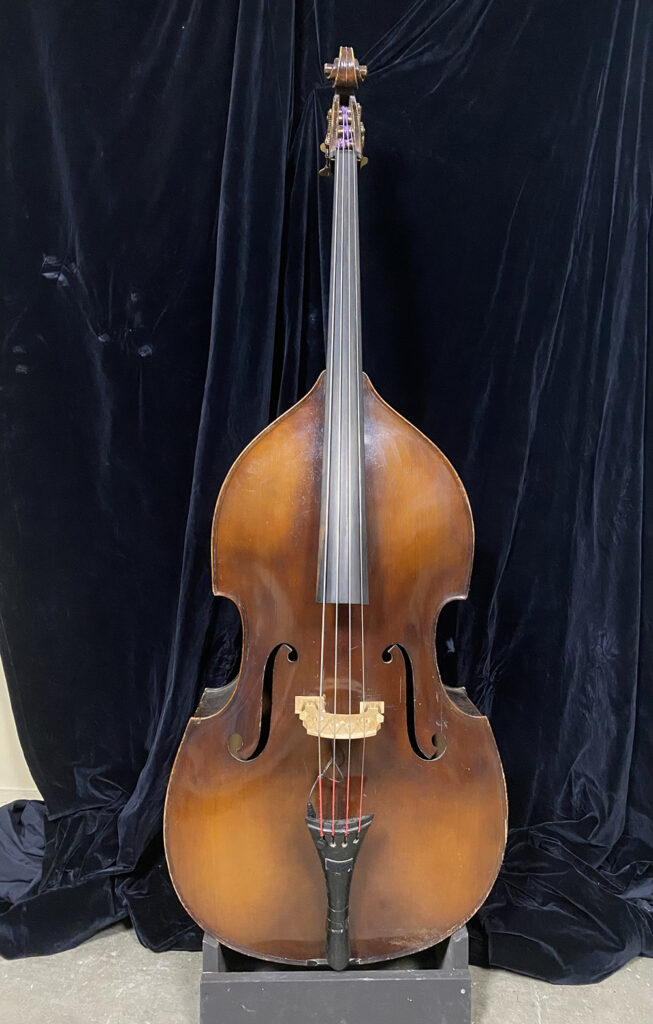
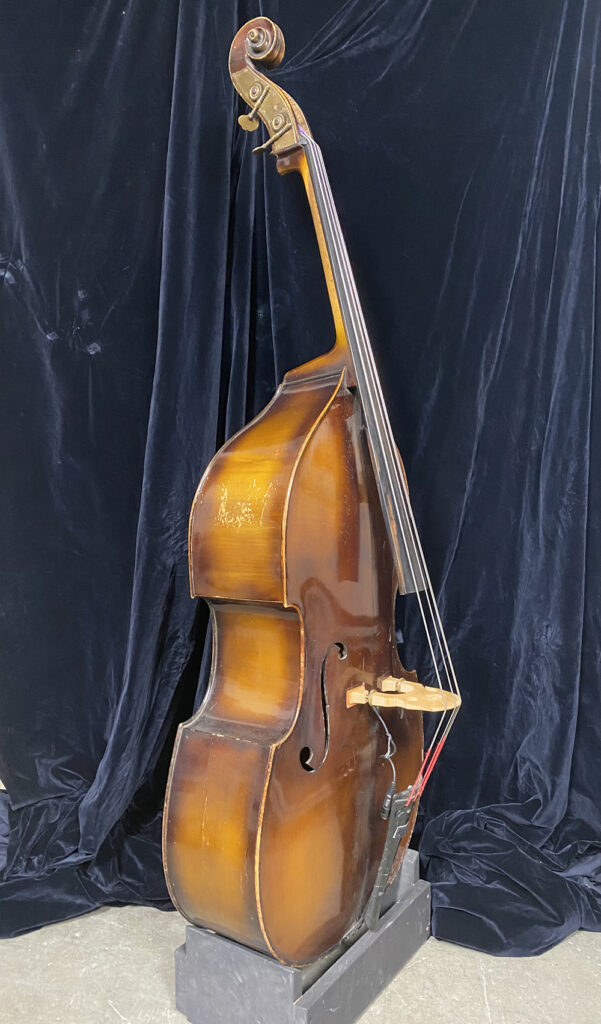
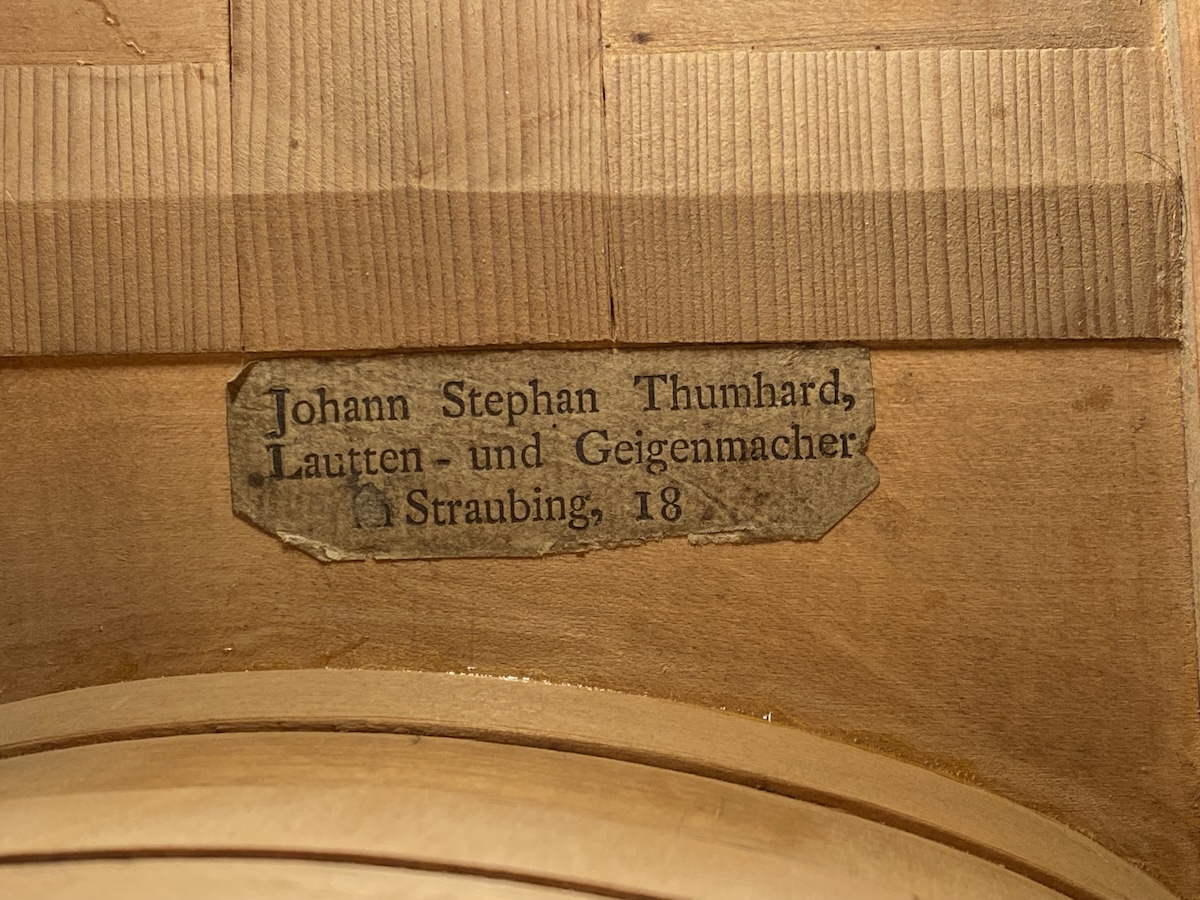
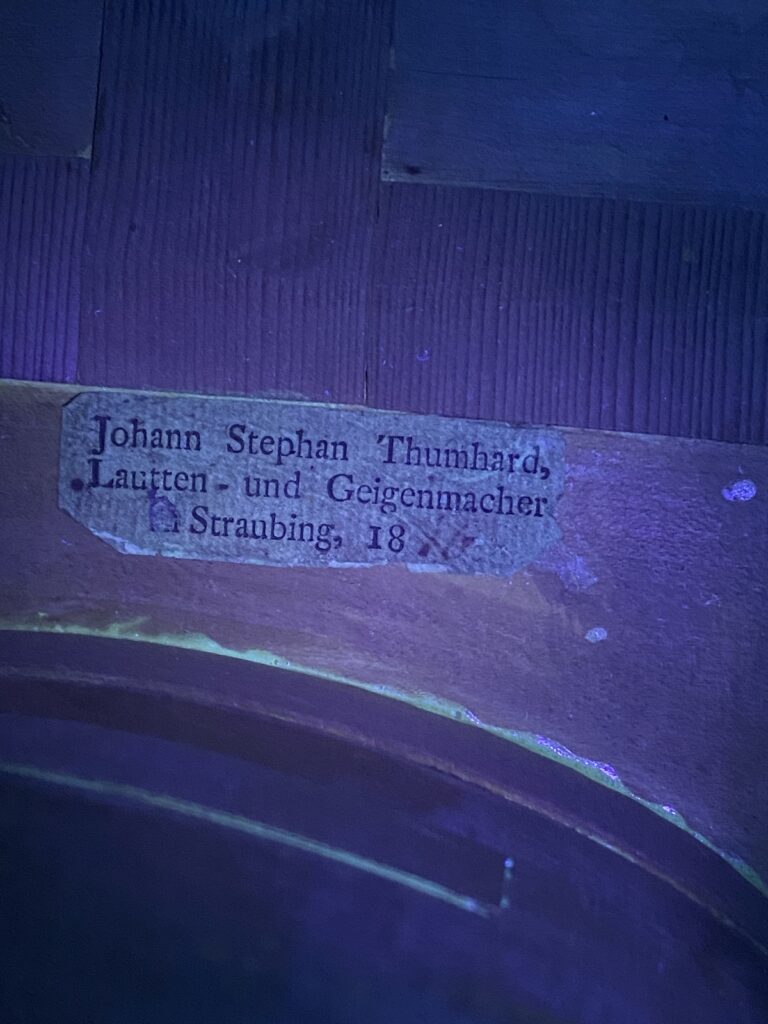
On my workbench today: half a bass with a note reading “Johann Stephan Thumhard.” The handwritten date is barely legible. A bit of UV light helps me make it out and reveals what might be a “16.” This suggests the bass was made a year before his death.
The Thumharts (Dumbhart) were a large family of violin makers who lived and worked in Bavaria (Amberg, Straubing, Ingolstadt, Munich) during the 18th and 19th centuries. Lütgendorff writes about Johann Stephan Thumhard:
Thumhardt, Joh. Stephan — Straubing. *1749, † 26. Dezember 1817
According to the Straubing trade register, he established himself there in 1769 as a violin and string maker, married in 1773, and handed over his workshop and estate to his son Alois in 1817. He may have been a pupil of Buchstädter, whose work he imitated quite closely. His better violins display a characteristic narrow model with elongated scrolls and sound quite good; however, his brown-yellow or brown varnish has mostly lost its luster. His gravestone still stands in the St. Peter’s Cemetery in Straubing, and on it one reads: “He was esteemed by his fellow citizens, and posterity will still praise him for his works of art. R. J. P.” The twelve violins he allegedly made for a wealthy connoisseur and eccentric are considered his finest. For the first, he received one ducat, which seemed too little to him, yet he said nothing when he was immediately commissioned to make a second, even better one. The customer then paid two ducats for it and demanded an even better one, for which he paid three ducats, and so on up to twelve ducats. Because of their number—twelve—these violins are called “Apostle Violins”; one of them (from 1793) is still owned today by District Court Judge F. Ebner in Straubing. In the same collection is a viola from 1782; a viola from 1809 is owned by musician Schmid in Straubing. The church choir at St. Jakob there also owns two violins from 1814 and 1815, as well as a particularly beautiful bass (1815) by Stephan Th. His violins have already fetched quite good prices, and his basses even higher ones.