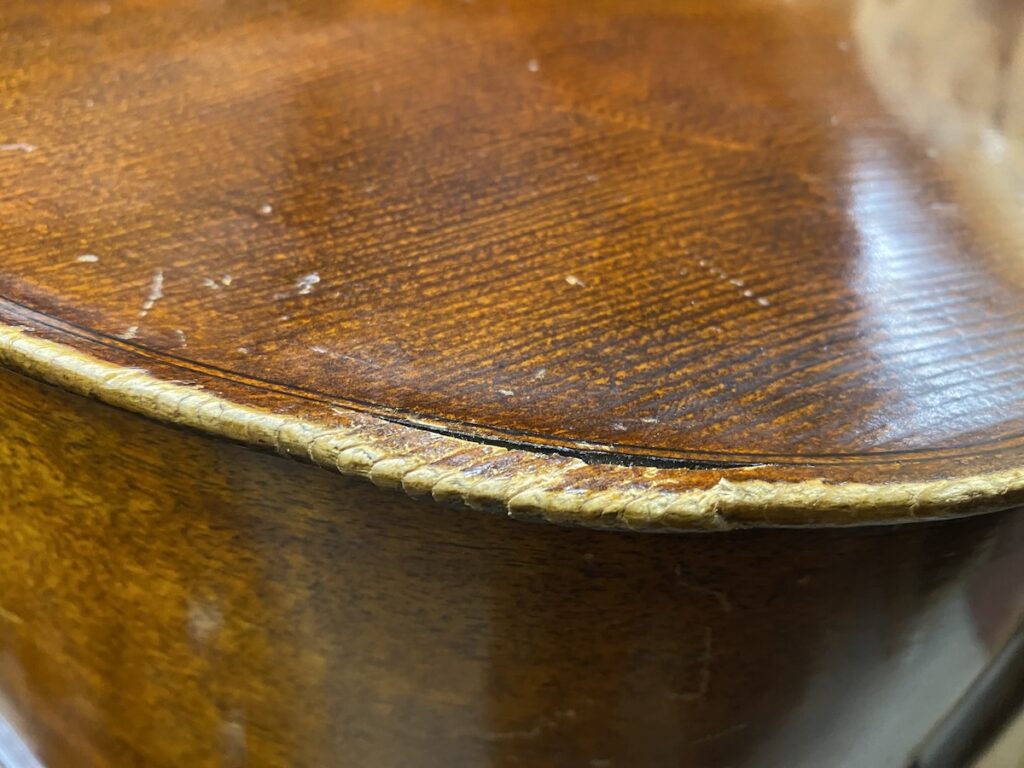
On double basses, the protruding edges of the top and back sometimes break off or splinter. On laminated double basses, this often only affects the outer layers of plywood.
On some basses, however, the purfling is merely painted on — especially plywood basses, but also many old Bohemian basses have no inlaid purfling. In violin-making literature, inlaid purfling is said to have a protective effect: cracks that run from the edge to the center are virtually “stopped” by the purfling running perpendicular. But is this really the case?
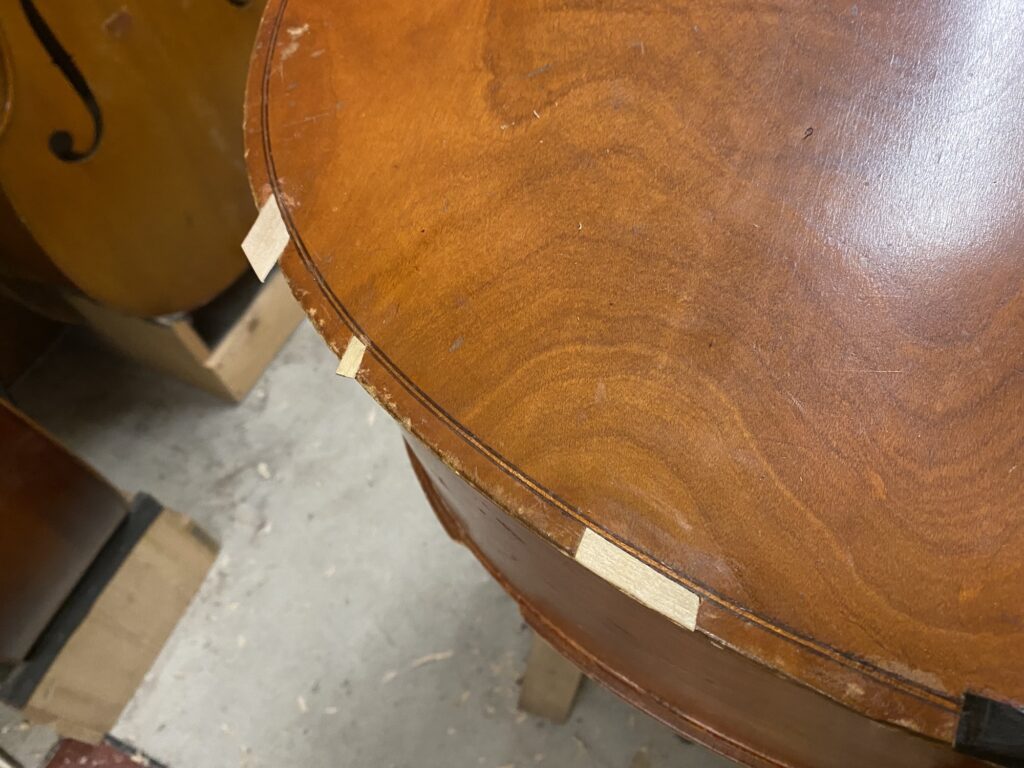
The plywood bass shown here clearly shows how the missing (and already replaced) pieces extend exactly to the inlaid purfling. Continuous cracks, which the purfling could stop, do not generally occur in plywood. But with some plywood basses, I have the impression that the narrow veneer edge splinters more easily precisely because the veneer has been cut through for the inserted chip. In that respect, this is not (only) a cost-saving workaround.
The situation is different with solid-wood basses (second photo). The edge was damaged and dented by an impact, and the wood has splintered along the grain. You can clearly see how the break ends at the purfling, and how this has helped to prevent the cracks from spreading further into the top. As no piece of wood was lost, this damage could be repaired very effectively.