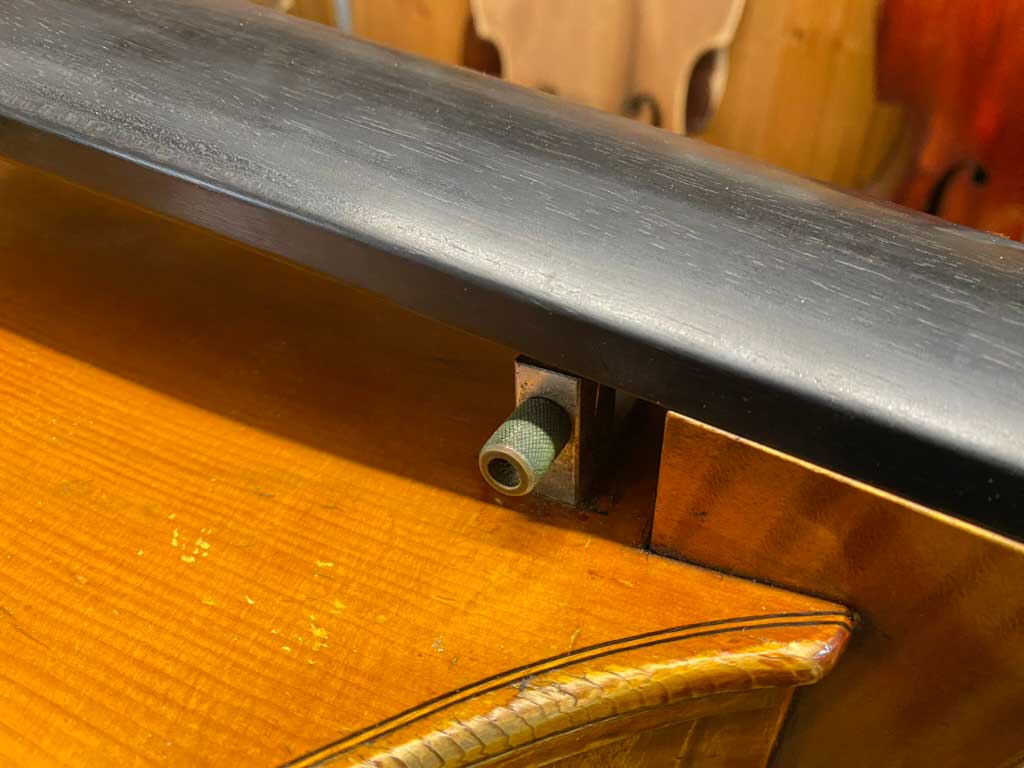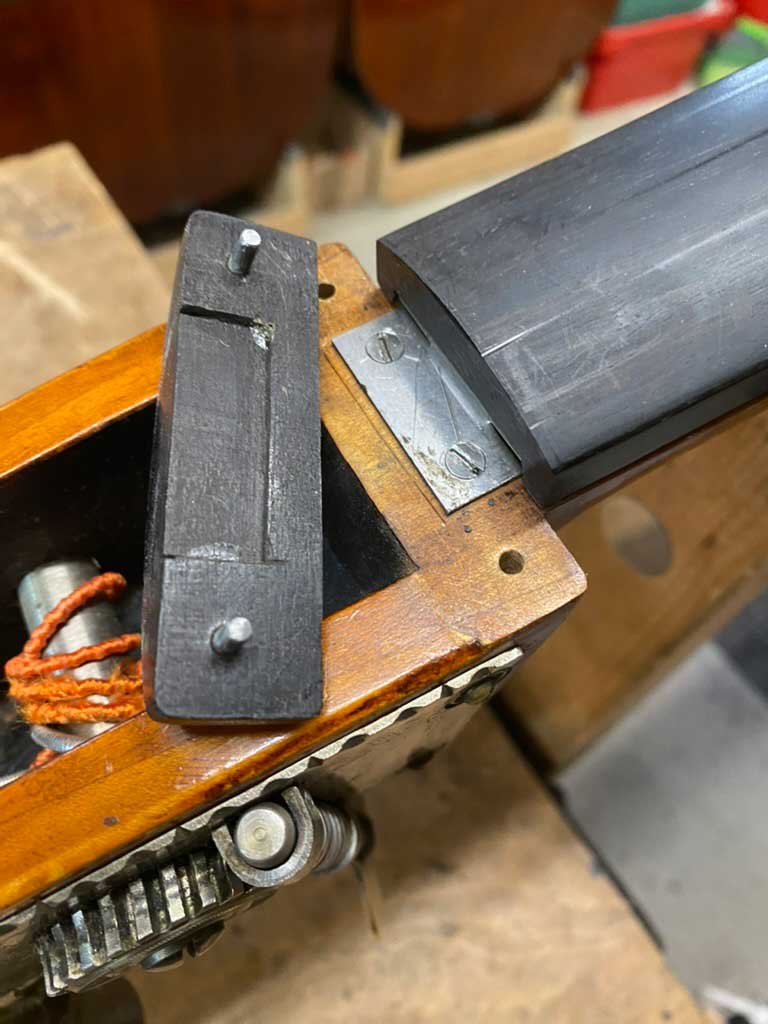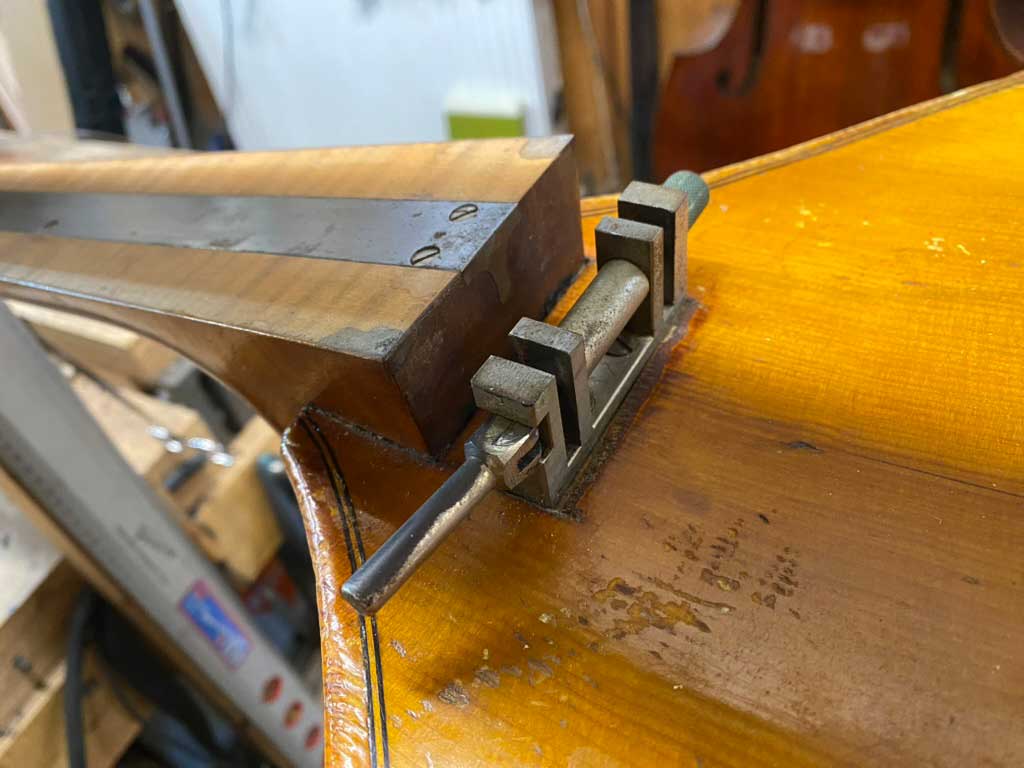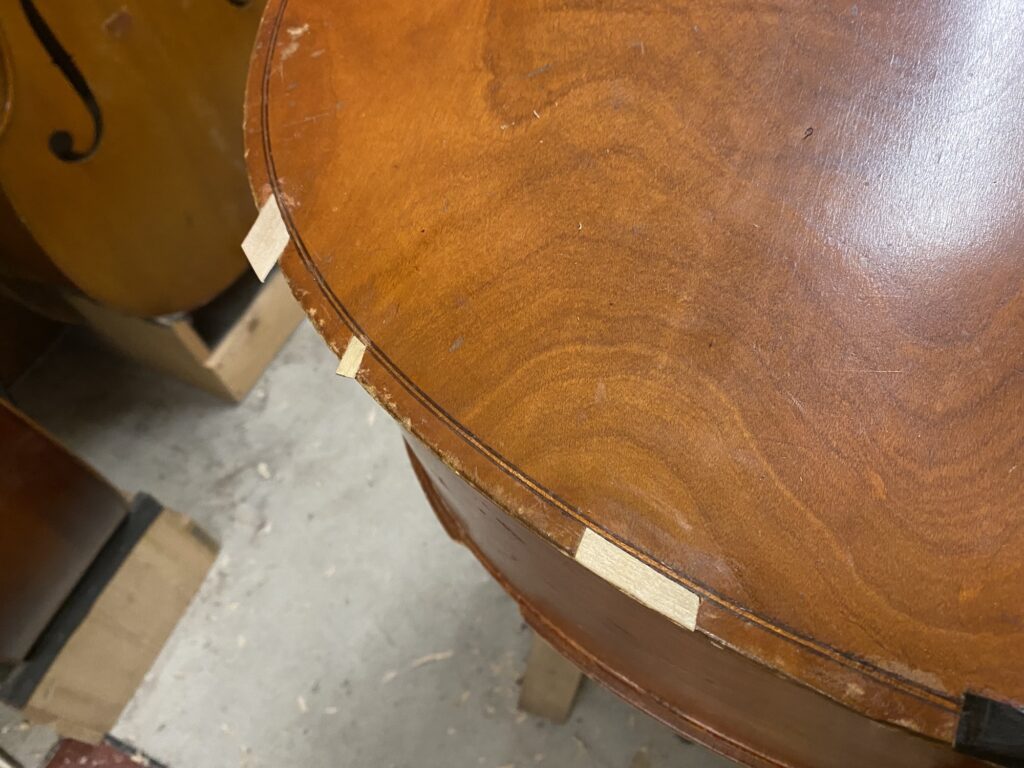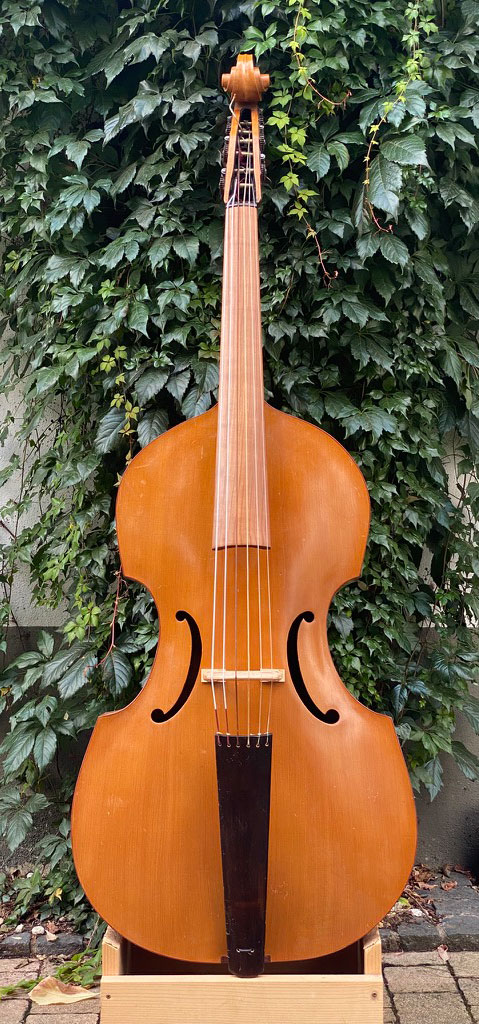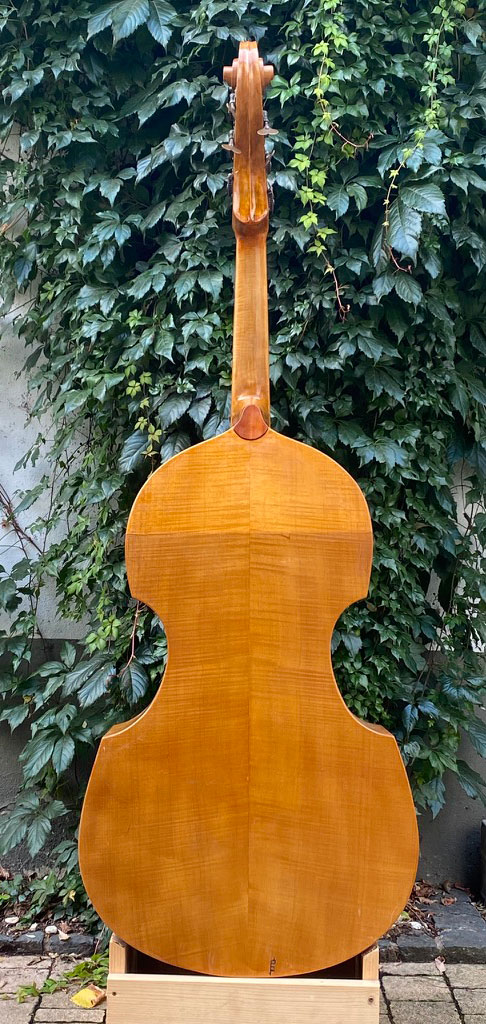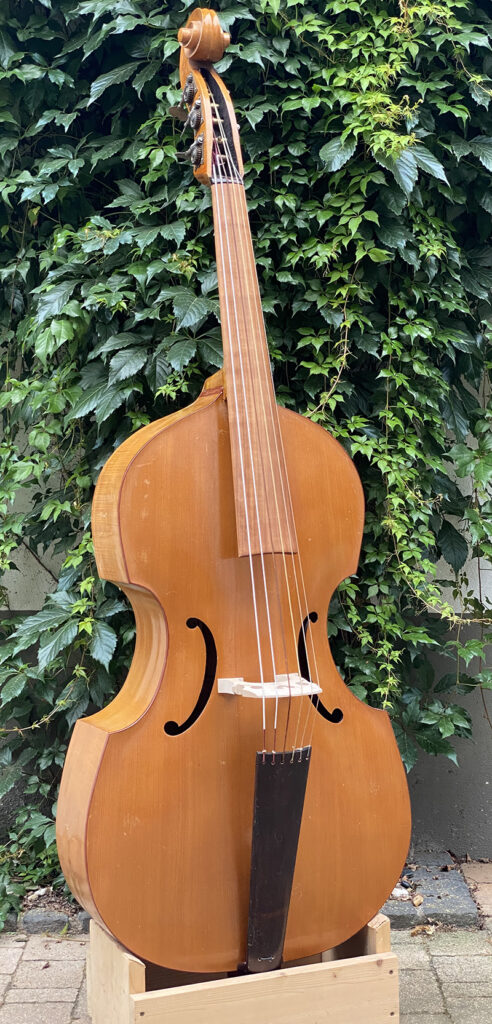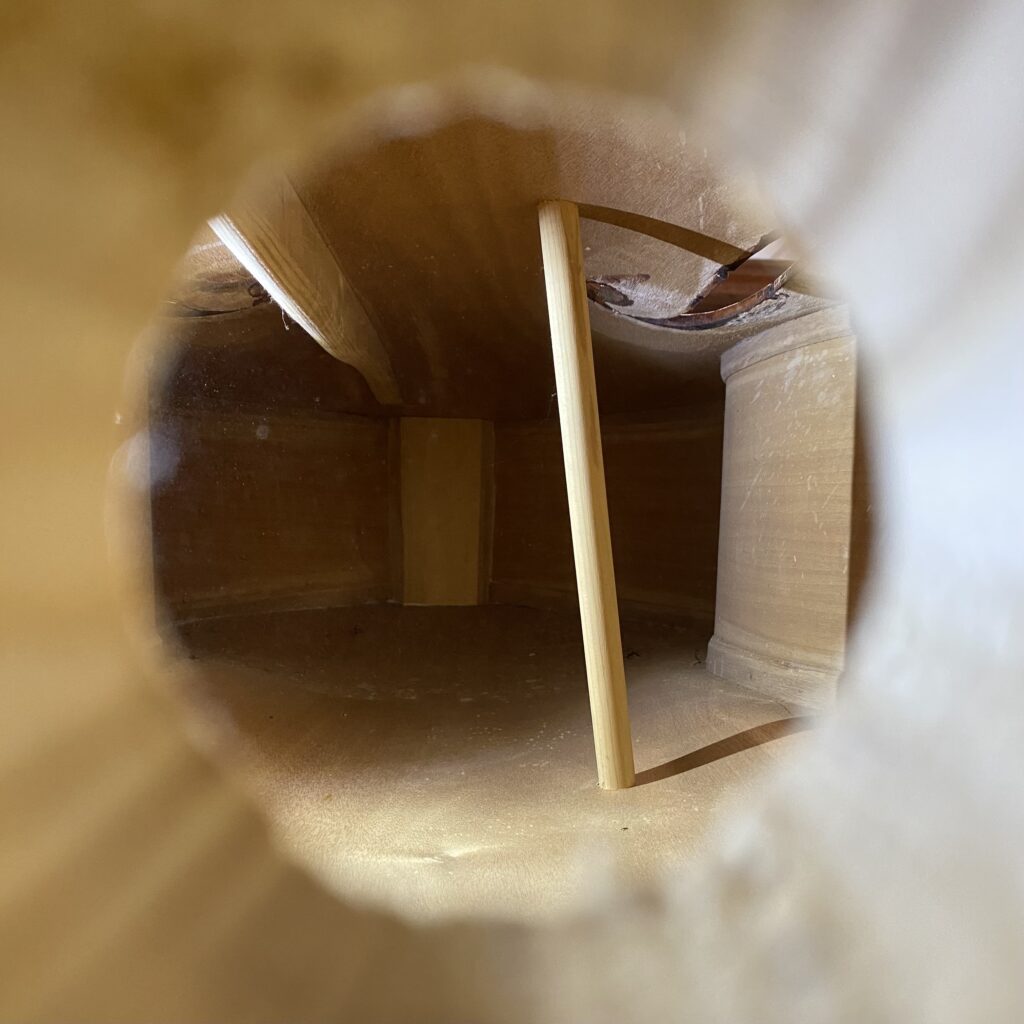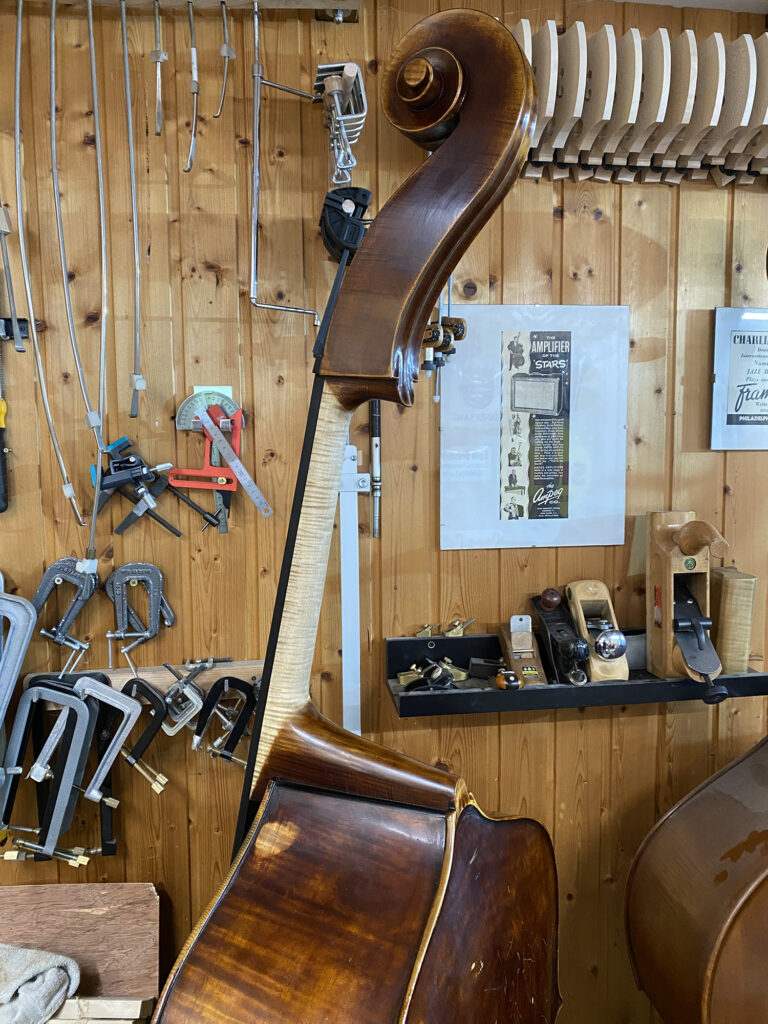
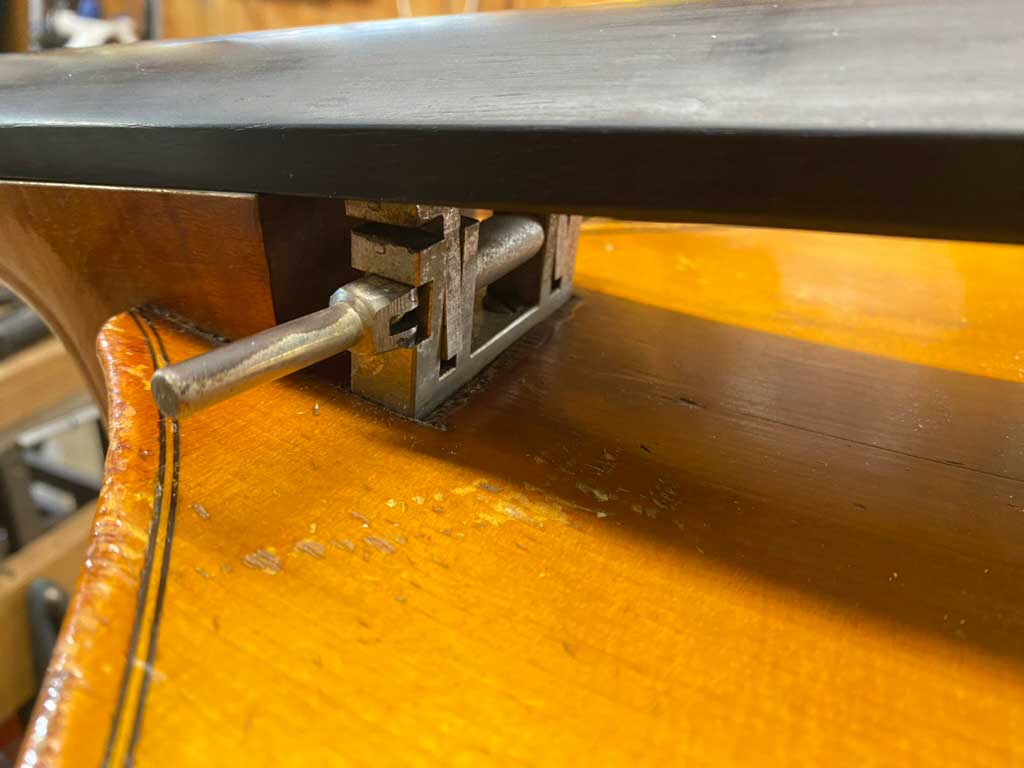
A double bass with six strings?!? No, a violone. This instrument, which belongs to the viola da gamba family, looks quite similar to a double bass, but the body is slightly larger than that of a ½ bass, while the scale length is slightly smaller at 90 cm. This G violone was built in 1962 by luthier Uebel in Celle/Germany. The tuning pegs are mounted in such a way that the direction of rotation of the pegs is the opposite of what you would expect from a bass. This means that you have to turn “downwards” to tune up. At first, I thought this was a mistake… something that can happen even to the most skilled instrument maker. However, I now assume that the tuning pegs were deliberately mounted this way so that the gut strings could be threaded over the pegs from below, rather than from above as is usually the case. This makes the angle at which the strings run over the nut slightly more acute, and the relatively thin and soft gut strings lie with a little pressure on the nut. The fairly wide notches in the original saddle indicate to me that the strings were previously strung in this way.
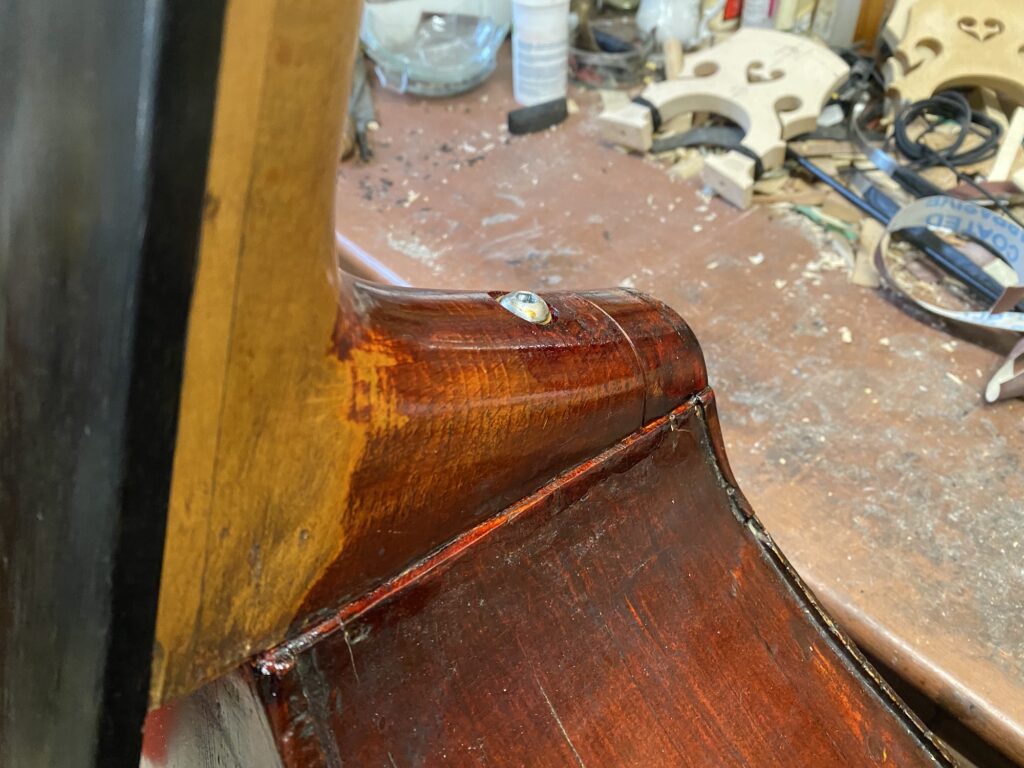
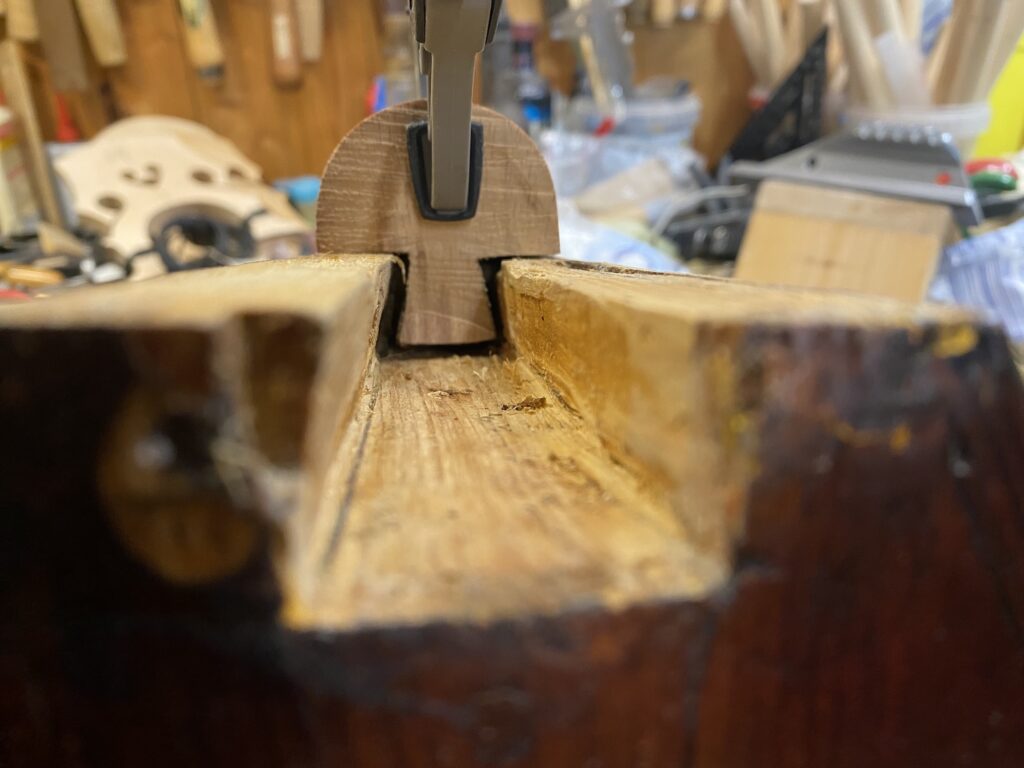
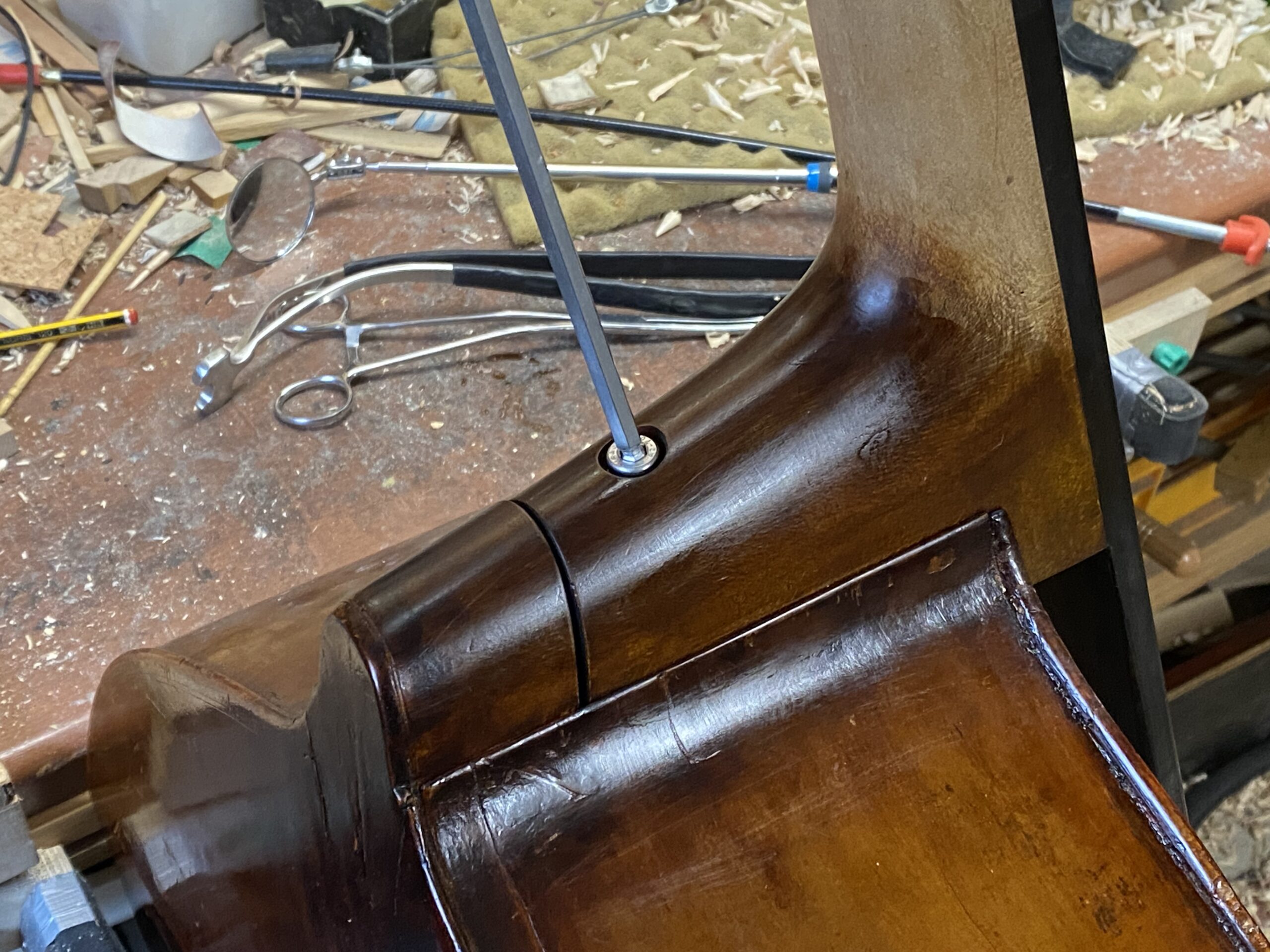
This Gofriller model bass had a neck break at the scroll box — one of the weakest points on a bass. Sometimes it is possible to repair this quite well and make it durable (I like to use carbon dowels for this), but in this case the customer opted for a new neck.
New arrival in the workshop: a double bass from the Vogtland region. Before the bass is playable again, it still needs a little work, but the substance is very good and pleasingly untouched. Even the original varnish is still in good condition and just needs a little touch-up.
It is not known which workshop built the bass – the bass has no label. However, the dealer who resold the bass at the time attached a small metal label to the back with two nails: “Wilhelm August Otto | musical instruments & strings | Markneukirchen in Saxony.” Metal labels like this, which were subsequently attached by dealers, are rather unusual on stringed instruments, but they are more common on (german) guitars. But at least the label gives us concrete information about the history of this bass, which often remains somewhat vague for most Vogtland instruments of this period.
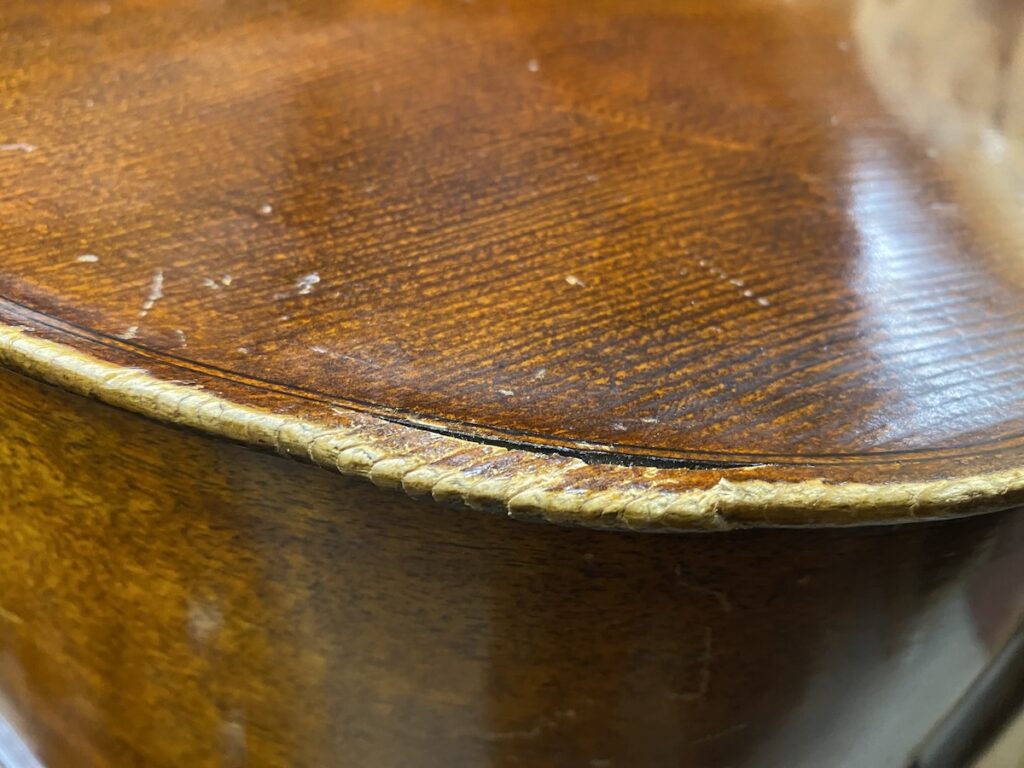
At a gig, a customer was embarrassed to have to use his smartphone as a cheat sheet. However, the gaffa tape used for this left some ugly craters in the varnish of the bass when it was removed. Reusable adhesive pads, such as those offered for mounting things on car dashbioards, are less dangerous for the varnish of a double bass. These adhesive pads do not use glue, but a vacuum, and therefore leave no adhesive residue on the bass. Depending on the condition of the varnish, they are certainly not completely safe, but my tests on various instruments did not reveal any problems when removing these pads.
Manufacturer Fischer offers such vacuum pads with Velcro backing. The specified adhesive force per set is 5 kg.
Like me, Phillipp Hahn, the owner of the Jazzkeller, is a passionate everyday cyclist. The Jazzkeller is also not far from us – otherwise I would have been a little worried about his transportation method when he brought the Jazzkeller bass to me on his Omnium because of a few open glue joints. His father Eugen‘s old Rubner then got an all-round check-up, and now the bass is ready for Europe’s most famous jazz club again.
This bass came to our workshop with a 50 cm long crack in the lower bout. It is not the first crack in the ribs that this instrument has experienced. The bass has a label from Friedrich Meindl, dated 1892 – Meindl built it at the age of 66, two years before his death. Lüttgendorf writes about Meindl:
“Meindl, Friedrich. Würzburg, † 1894, son of Franz X. M., pupil of his father and Vauchel. He concentrated entirely on the construction of stringed instruments and trained in this during his time as an assistant in good workshops. In 1864 he took over his father’s (zither-making) workshop. He was a very clean and diligent worker until the end of his life and made many violins and violoncellos. He used beautiful wood and a self-prepared spirit varnish (golden-yellow ground and cherry-red colored varnish).”
Fortunately, he left the golden yellow base for this double bass – because cherry red no longer quite meets today’s taste …
Please send us an e-mail if you require further information or would like to order something. Or simply drop by our shop in Frankfurt!
Zustimmung verwalten
Um dir ein optimales Erlebnis zu bieten, verwenden wir Technologien wie Cookies, um Geräteinformationen zu speichern und/oder darauf zuzugreifen. Wenn du diesen Technologien zustimmst, können wir Daten wie das Surfverhalten oder eindeutige IDs auf dieser Website verarbeiten. Wenn du deine Zustimmung nicht erteilst oder zurückziehst, können bestimmte Merkmale und Funktionen beeinträchtigt werden.
Funktional
Always active
Die technische Speicherung oder der Zugang ist unbedingt erforderlich für den rechtmäßigen Zweck, die Nutzung eines bestimmten Dienstes zu ermöglichen, der vom Teilnehmer oder Nutzer ausdrücklich gewünscht wird, oder für den alleinigen Zweck, die Übertragung einer Nachricht über ein elektronisches Kommunikationsnetz durchzuführen.
Vorlieben
Die technische Speicherung oder der Zugriff ist für den rechtmäßigen Zweck der Speicherung von Präferenzen erforderlich, die nicht vom Abonnenten oder Benutzer angefordert wurden.
Statistiken
Die technische Speicherung oder der Zugriff, der ausschließlich zu statistischen Zwecken erfolgt.Die technische Speicherung oder der Zugriff, der ausschließlich zu anonymen statistischen Zwecken verwendet wird. Ohne eine Vorladung, die freiwillige Zustimmung deines Internetdienstanbieters oder zusätzliche Aufzeichnungen von Dritten können die zu diesem Zweck gespeicherten oder abgerufenen Informationen allein in der Regel nicht dazu verwendet werden, dich zu identifizieren.
Marketing
Die technische Speicherung oder der Zugriff ist erforderlich, um Nutzerprofile zu erstellen, um Werbung zu versenden oder um den Nutzer auf einer Website oder über mehrere Websites hinweg zu ähnlichen Marketingzwecken zu verfolgen.